
ELA and social studies, done in one block
Inkwell integrates core K–2 ELA and social studies into a single 70-minute block. It replaces separate ELA, writing, grammar, and social studies programs. Aligned to the Science of Reading, it’s designed to sit alongside your foundational skills curriculum.


Meet Inkwell
Inkwell is an inquiry-based HQIM for both ELA and social studies, designed so each subject strengthens the other. Students develop their literacy by reading, writing, and discussing within sustained social studies investigations.
- Supports mastery of ELA and social studies standards in one block
- Grounded in the Science of Reading
- Embeds explicit writing instruction in daily lessons
- Builds knowledge through content-rich social studies investigations
- Connects and deepens learning through inquiry
K–2 ELA and social studies, aligned to the Science of Reading
A new approach to HQIM:
Integrated ELA and social studies
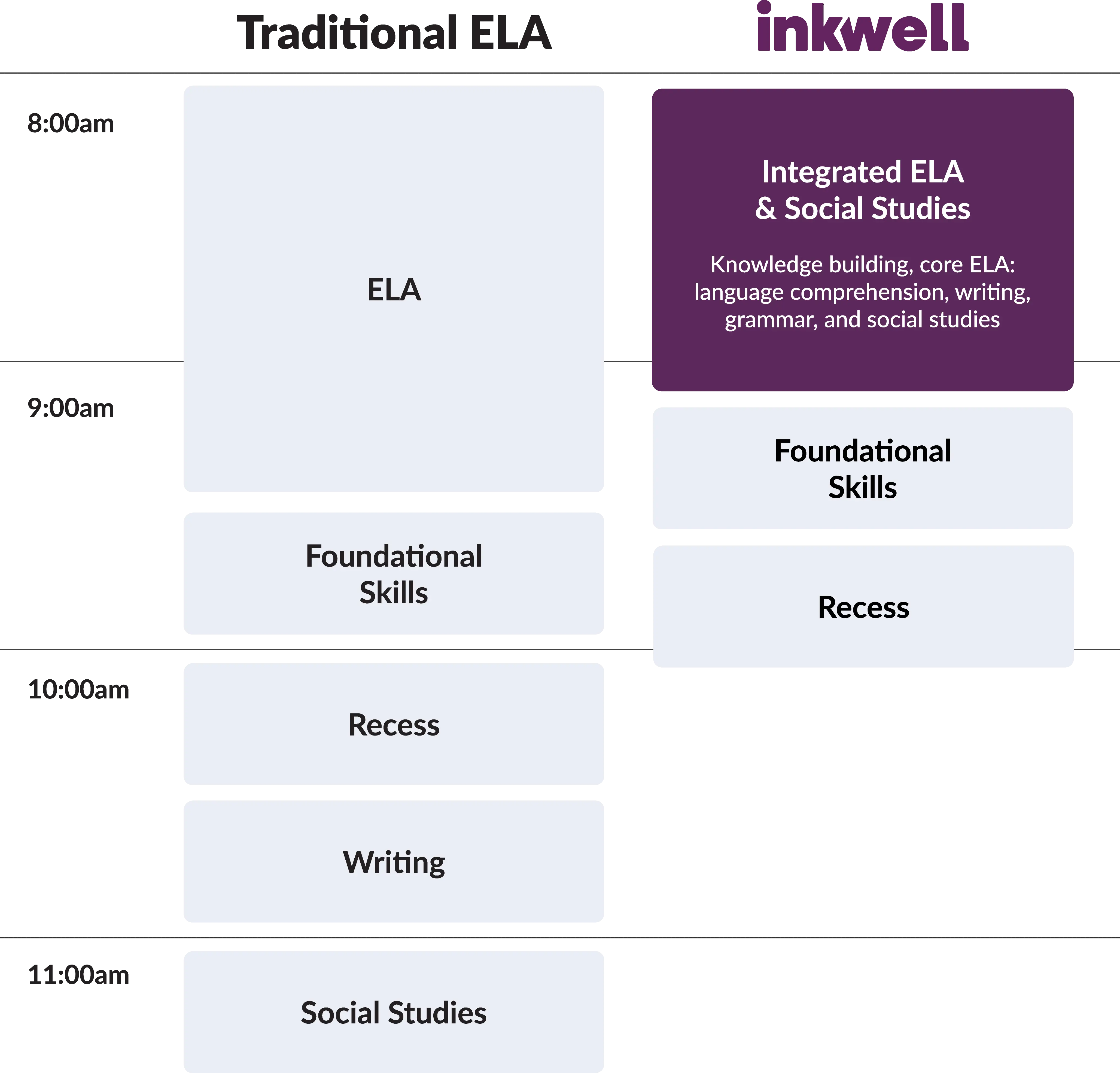
ELA and social studies, done by recess
Inkwell’s 70-minute block replaces two separate ELA and social studies blocks. Teachers no longer have to choose between ELA and social studies, and the time they get back goes to foundational skills, math, and intervention.
- One block covers two core subjects designed to work together.
- No second prep and no second pacing guide to manage.
- Foundational skills stay protected in their own block.
- Students read, write, and discuss social studies, so every task strengthens literacy and content knowledge at once.
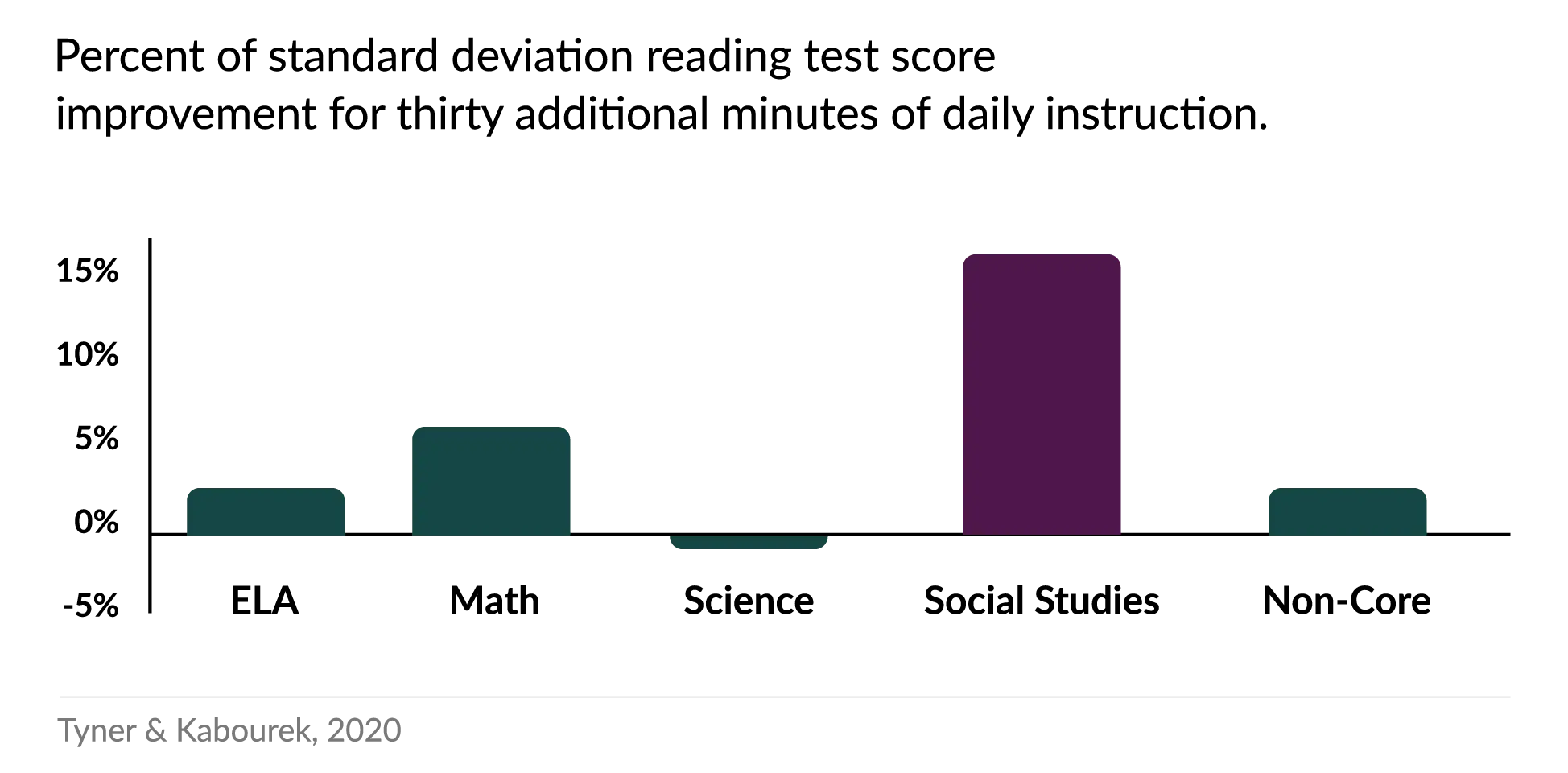
The research shows social studies boosts reading
Inkwell's integrated design builds the background knowledge and academic vocabulary that comprehension depends on. In every unit, students put that knowledge to work on a new text, task, or problem, deepening understanding and extending learning.
- Develops a coherent social studies knowledge base, giving every text a meaningful place in a larger investigation.
- Builds knowledge that transfers, revisiting and applying social studies learning across lessons, units, and grade levels.
- Teaches academic vocabulary within authentic contexts, making it more meaningful and memorable.
Solve the blank page problem
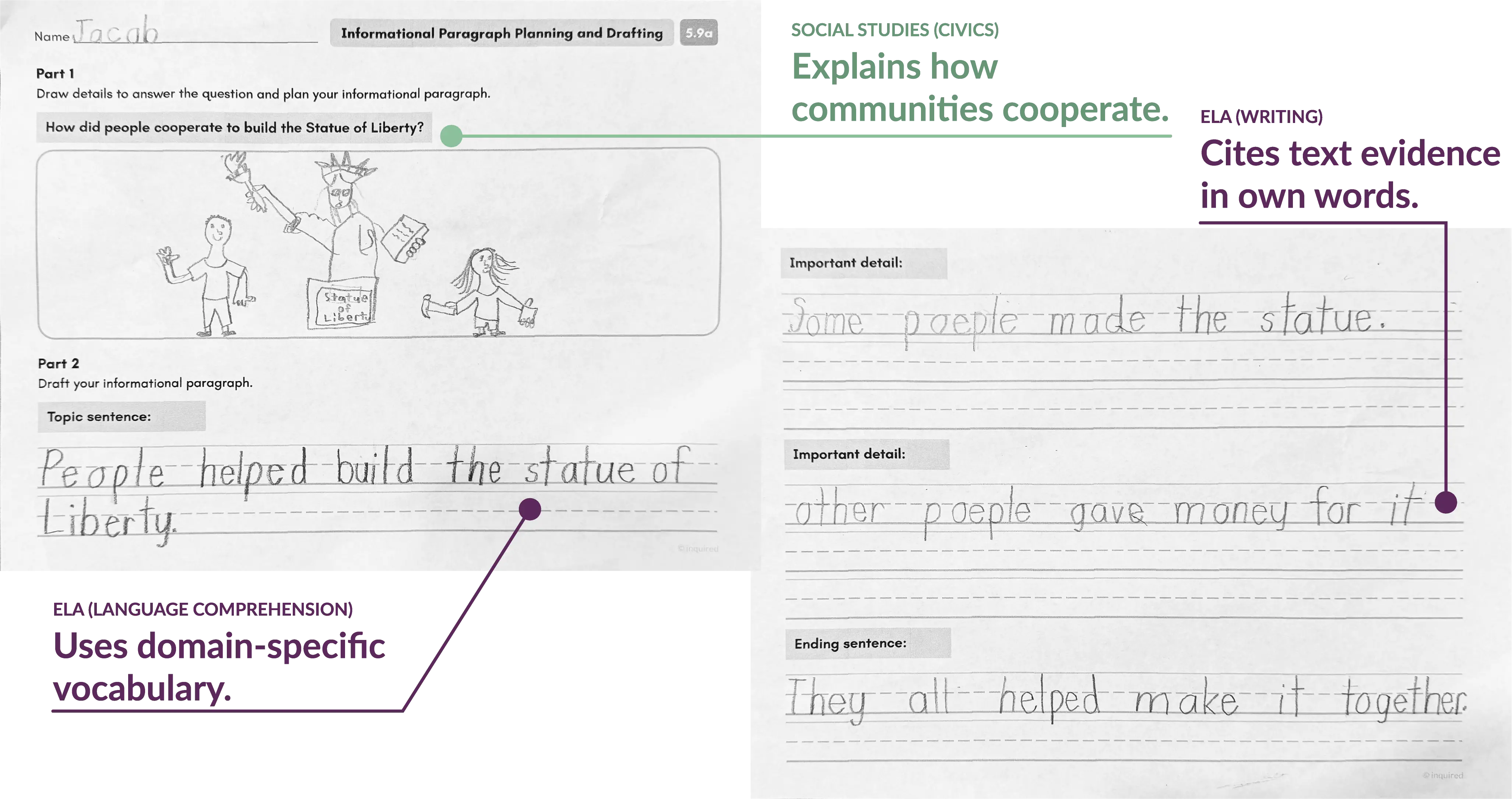
Inkwell writing starts with explicit daily instruction where students write to make meaning of texts. Then, it asks students to go one step further and use the knowledge they’ve built as evidence for a broader disciplinary idea.
- Explicit writing instruction tied to the texts, sources, and discussions students explore every day.
- Students write to investigate compelling social studies questions about real people, places, and communities.
- As students build social studies knowledge, they write (and discuss) to explain their thinking, inform, and persuade an audience beyond the classroom.
- When students have something to say, and know how to say it, the blank page shifts from an obstacle to an invitation.
.webp)
The research points to the value of integrated curriculum
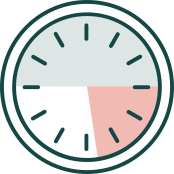
An elementary day built entirely from separate research-based programs, plus transitions, runs at least 2 hours 40 minutes past the time a school day actually holds.
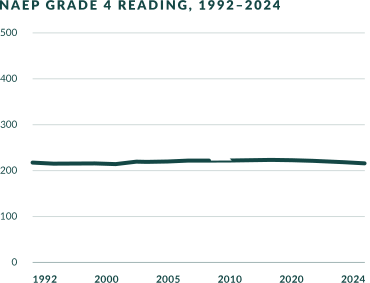
“Teachers and students were doing text-based comprehension work, but most of that work was skimming the surface rather than supporting a deeper understanding of texts.”
Read the full brief
The time, budget, and comprehension case for integrated ELA and social studies.
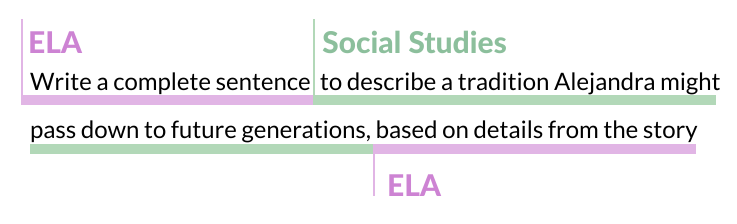
The rigor of HQIM ELA and social studies, in every line of every lesson
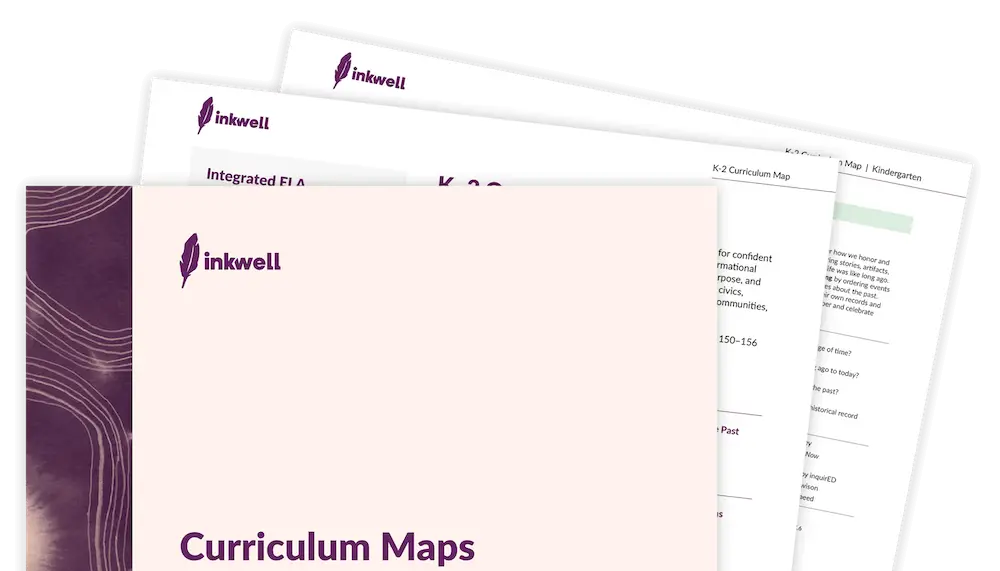
See how knowledge builds, year-over-year
The Inkwell Curriculum Map shows how learning unfolds across K–2, including each unit’s social studies focus, anchor texts, connections to standards, and year-over-year development.
Download to see the scope and sequence at a glance and understand how content and standards progress across grades.
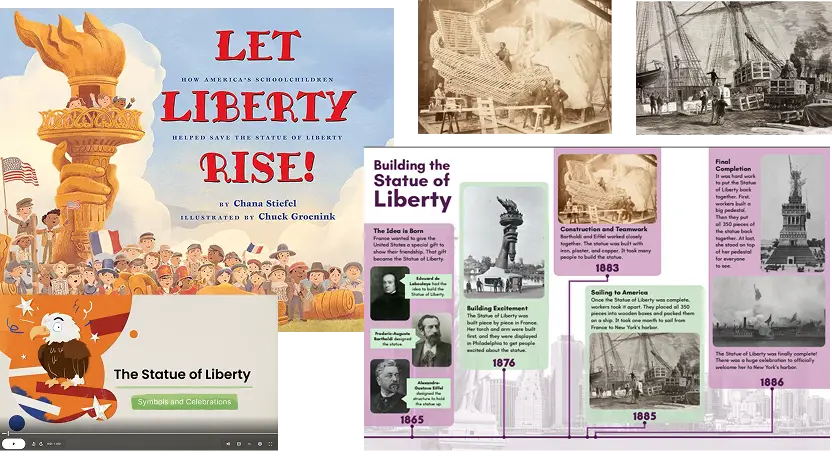
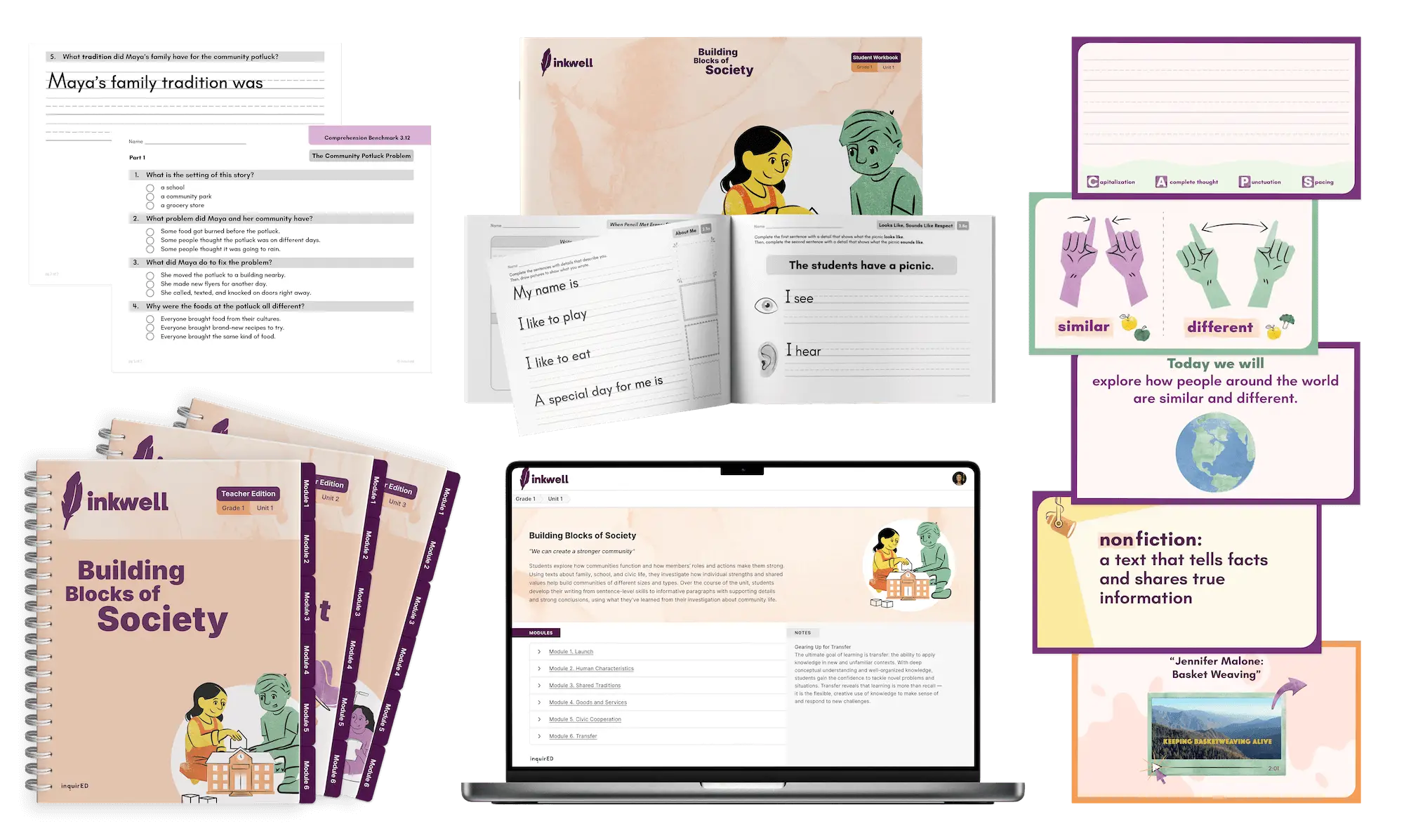
Inquiry-based instructional materials, with everything you need for ELA and social studies
Teacher Materials
Print and digital materials come ready to teach.
- Teacher Edition: one curriculum to learn instead of two, with both subjects in every lesson
- Flexible Learner Supports Guide: extra support that stays tied to the unit's content
- Vocabulary Cards: core words stay in view all unit, a reference for discussion and writing
- Trade Book Sets: complex texts, paired with primary and secondary sources, for deeper comprehension
Student Materials
Hands-on materials made for deep comprehension and investigations.
- Sourcibles: content-rich primary and secondary sources in every student's hands
- Checkpoint Magazine Assessments: a full-color magazine and assessment that your students will love
- Classroom Activity Materials: card sorts, manipulatives, and posters for hands-on learning
Taking a look at what’s inside Inkwell’s K–2 integrated ELA and social studies units
Unit 1: Working Together
In this unit, students learn about roles, rules, and teamwork through stories, informational texts, and other sources that show how people help one another at home and school. They practice informative writing by drawing, dictating, and writing simple facts about their community. Together, students demonstrate how their classroom has become a caring community where everyone contributes.
Unit 2: Navigating and Caring for Our Surroundings
In this unit, students explore how movement, seasons, and resources shape daily life through informational texts, maps, and stories. They practice opinion writing by expressing preferences and reasons for caring for people, animals, and places. Students share ideas and actions for how people and animals can use and care for their surroundings.

Unit 3: Preserving the Past
In this unit, students discover how we honor and learn from the past by exploring stories, artifacts, and other examples of what life was like long ago. They practice narrative writing by ordering events and sharing reactions to stories about the past. Students create and share their own records and stories to help people remember and celebrate important moments.

Unit 1: Building Blocks of Society
In this unit, students explore how communities function and grow strong. Using texts and other sources about family, school, and civic life, they investigate how individual strengths and shared values help different communities thrive. Students also practice informative writing, developing from sentence-level to paragraph writing with supporting details and clear conclusions. As the unit concludes, students identify opportunities to strengthen their own community through a shared project.
Unit 2: Adaptations to the Environment
In this unit, students investigate the relationship between people and the places they live. Using stories, informational texts, maps, and other sources, they explore how land, water, climate, and resources shape daily life. Students also practice narrative writing, developing from sentence construction to sequenced stories using descriptive language. As the unit concludes, students reflect and share ideas for caring for the places where they live.
Unit 3: Civic Foundations
In this unit, students examine how communities stay safe and fair through shared rules, laws, and leadership. Using stories and informational texts, they investigate decision-making, responsibility, and citizenship, exploring how everyone contributes to their community's well-being. Students also practice opinion writing, crafting pieces with clear reasons and conclusions. As the unit concludes, students identify a community need and share ideas to take action for the common good.
Unit 1: Changing Landscapes
In this unit, students examine how people and environments interact and change over time. Using informational texts and stories, they learn about Indigenous traditions, explore migration and expansion, and study efforts to preserve shared spaces like national parks. Students practice informative writing by introducing topics, supporting them with details, and explaining why the information matters. As the unit concludes, students reflect and plan ways to care for and protect the land.
Unit 2: Community Needs and Wants
In this unit, students explore how choices about resources shape communities and daily life. Using informational texts, stories, and other sources, they investigate economic concepts like saving and spending, production, trade, and entrepreneurship. Students practice narrative writing by recounting meaningful events with clear sequences, descriptive details, and endings that bring closure. As the unit concludes, students explore ways to use resources wisely in their own communities.

Unit 3: Innovation
In this unit, students examine how creativity and problem-solving drive change. Using stories, informational texts, and other sources, they study historical and literary examples of innovation, learning about the importance of persistence and collaboration. Students practice opinion writing by introducing a topic, stating an opinion, giving reasons, and concluding with a clear point of view. As the unit concludes, students show how innovation and perseverance can improve their communities.
Join an upcoming webinar episode
Lit Talk with Dr. Nell K. Duke
Live webinars with Dr. Nell K. Duke (and guests!) talking at the intersection where literacy research meets classroom practice.
Inkwell Product Demo
The nuts and bolts about how we got core ELA and social studies into one 70-minute block. Bring your questions!
Learn more about our approach to high quality instructional materials
integrated ela
Integration in Elementary Instruction
Integrating ELA and social studies into a single instructional block supports deeper knowledge-building, stronger comprehension, and transfer across contexts.
integrated ela
writing
Writing for Meaning and Understanding: The Power of Integrated ELA and Social Studies
Strong writing instruction depends on explicit teaching, purposeful practice, and meaningful content.
integrated ela
knowledge building
Deeper knowledge and comprehension
through ELA and social studies
integration
Integrated ELA and social studies strengthens reading comprehension by building two layers of knowledge at once.
The research case for integrating ELA and social studies
A short, district-ready brief on why integration builds knowledge and strengthens literacy outcomes, with the evidence behind it.
Get the brief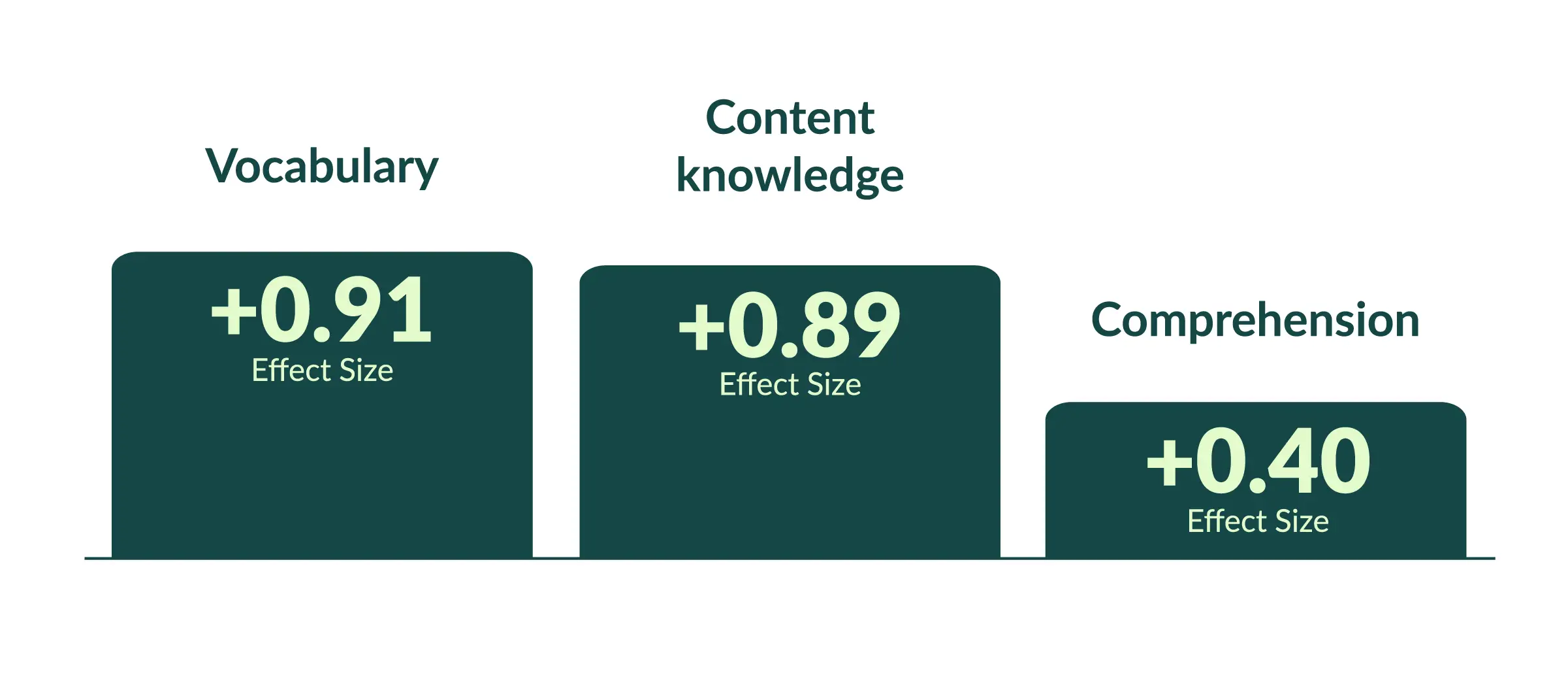
Learn more about our programs



FAQ
What is Inkwell?
Inkwell is inquirED’s K–2 integrated curriculum that brings core ELA and core social studies together into one instructional block. Students build reading, writing, speaking, listening, and language skills within the context of building social studies knowledge about communities, civic life, and the world around them.
What does “integration” mean in Inkwell?
In Inkwell, integration means that ELA and social studies are intentionally designed together. Students read, write, discuss, and investigate social studies topics using rich texts and sources, so literacy skills and content knowledge develop side by side rather than separately.
How is Inkwell different from teaching ELA and social studies as separate subjects?
Instead of dividing time between separate blocks, Inkwell addresses ELA and social studies standards within a single lesson. Literacy skills are taught explicitly, but always in the context of meaningful social studies investigations. This creates coherence for teachers and helps students apply skills to real ideas and questions.
Is Inkwell aligned to standards?
Yes. Inkwell is designed to meet both ELA standards and state social studies standards. ELA standards shape daily instruction in reading, writing, language, and speaking and listening within the context of standards aligned social studies content and disciplinary skills. For more information on alignment to state standards or requirements, please contact us here.
Is Inkwell grounded in the science of reading?
Yes. Inkwell’s approach to reading comprehension and language development is grounded in the science of reading, with an emphasis on knowledge building, explicit instruction, and regular practice with complex texts.
Will we need a foundational skills program in addition to Inkwell?
Yes. Inkwell is designed to be used alongside a high-quality foundational skills program that provides systematic phonics instruction.
How does Inkwell approach writing instruction?
Writing is taught explicitly and practiced daily. Students write to learn and learn to write about what they read and discuss. Instruction begins at the sentence level and builds toward longer pieces of writing across genres over time, all connected to social studies content.
How is Inkwell structured?
Each grade level includes three units per year. Units are organized into modules:
- A Launch Module that introduces the inquiry and builds curiosity
- Investigation Modules that develop knowledge, literacy skills, and writing
- A Transfer Module where students apply learning in a new or authentic context
This structure supports coherence, skill progression, and meaningful application of learning.
How long is an Inkwell lesson?
Each Inkwell lesson is designed for a 70-minute instructional block. Lessons are divided into two 35-minute segments, giving teachers flexibility to pause, regroup, or adjust pacing based on student needs.
Which grade levels are currently available?
Inkwell is available for Kindergarten through Grade 2. To learn more about the timeline for Grades 3–5, please contact us here.
What kinds of texts do students read in Inkwell?
Students engage with a range of high-quality literary and informational texts, including trade books, primary and secondary sources, and multimedia. Texts are intentionally sequenced to build knowledge over time and support discussion, vocabulary development, and writing.
How does Inkwell support all learners?
Inkwell includes built-in Tier 1 support in every lesson so all students can engage with grade-level content within core instruction. Lessons use predictable routines, visuals, structured discussion, oral rehearsal, and explicit language support to support students in making sense of texts and ideas.
How does Inkwell support multilingual learners?
Multilingual learner supports are embedded directly into lesson plans and aligned to WIDA, including sentence frames, modeled language, opportunities for talk before writing, and scaffolds that support comprehension and expression. These supports are designed to keep students engaged with the texts, questions, and learning goals.
What materials are included with Inkwell?
Inkwell includes both print and digital components. Teachers have access to lesson plans, slide decks, sources, and assessment resources and guidance through a digital subscription. Print materials include trade books, Sourcibles, vocabulary cards, student workbooks, and other consumables.