Curriculum

Elementary

Social Studies

COMING SOON

Integrated ELA & Social Studies

inkwell-logo-white

Middle School

Social Studies

Upcoming Product webinar

Explore

inquiry journeys logo

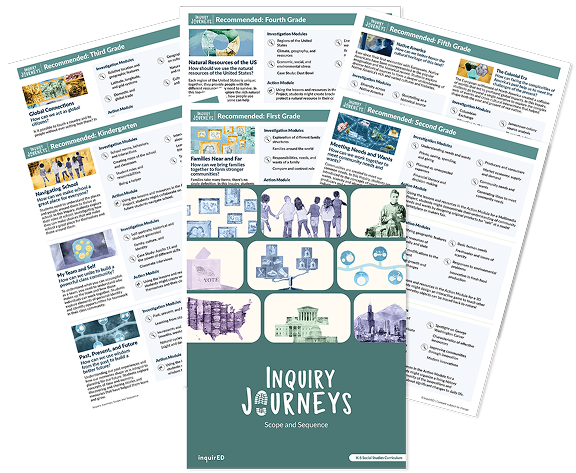
Join inquirED this fall for Exploring Inquiry Journeys, a webinar series for school and district leaders. Each session offers practical insights and strategies from our curriculum to engage students and support teachers in inquiry-based elementary social studies.

Register
Professional Learning
Resources

Resource Collections

Downloadable guides, frameworks, and tools designed to help district leaders take action on social studies curriculum and instruction. Looking for our most downloaded resesources? Check the quick links below.

Curiculum Review Guide

Literacy in Social Studies Rubric

Social Studies Pacing Guide

Blog

Fresh ideas, research, and reflections to help district leaders stay sharp and responsive in an evolving social studies landscape.

Webinars

Real-time conversations and on-demand learning with experts and district leaders tackling challenges in social studies education.

NCSS & inquirED

Product Webinars

Webinar Library

free resource

Social Studies Curriculum Review Guide

Download this free tool designed to help educators, districts, and curriculum developers create, evaluate, and select social studies instructional materials that meet the demands of today’s classrooms.

Download
Log inContact sales
Log in
Contact sales

Contact sales

Cookie Settings

We use cookies to provide you with the best possible experience. They also allow us to analyze user behavior in order to constantly improve the website for you. See our Privacy Policy

Thank you! Your submission has been received!
Oops! Something went wrong while submitting the form.
Webinars

Background Knowledge and the Science of Reading

Featured speakerS
Nell K. Duke

Nell K. Duke

Executive Director for the Center for Early Literacy Success at Stand for Children
Katherine Tarca

Katherine Tarca

Director of Literacy and Humanities for Massachusetts Department of Elementary and Secondary Education
Shanti Elangovan

Shanti Elangovan

CEO and Founder of inquirED
Sarah Schwartz

Sarah Schwartz

Reporter for Education Week

NOTE: There is no recording for this webinar.

Feb 27, 2023
7
MIN READ
Copied!

I am the text that will be copied.

Webinars
BACK TO BLOG

Background Knowledge and the Science of Reading

Feb 27, 2023
7
MIN READ
Copied!

I am the text that will be copied.

Table of Contents
H1 Heading
H2 Heading
H3 Heading
Table of Contents
H2 Heading
H3 Heading
H4 Heading

K-5 Social Studies Curriculum

illustration of kid holding question mark

Book a demo

illustration of kid holding question mark

Explore Inkwell!
K–2 integrated ELA and social studies

What role does background knowledge play in building literacy skills? How can social studies instruction support the development of these skills through knowledge building? We asked these questions during our webinar, where we were joined by Nell K. Duke, Executive Director for the Center for Early Literacy Success at Stand for Children; Katherine Tarca, Director of Literacy and Humanities for Massachusetts Department of Elementary and Secondary Education; Shanti Elangovan, CEO and Founder of inquirED; and Sarah Schwartz, a reporter for Education Week. Read below for a summary of our discussion.

Key Takeaways

  • Instruction that integrates ELA skills and social studies content is more robust and shows positive effects.
  • Social studies instruction should exist for the sake of social studies instruction; there is great value in the direct teaching of social studies education.
  • In order to teach social studies within the constraints of instructional minutes, one must be incredibly intentional about ensuring skills and content are woven together.
  • When building background knowledge, it is crucial to consider the lived experience and historical knowledge of the students in our classrooms.

Foundations: Literacy Skills and Background Knowledge

Opening the conversation, Sarah Schwartz shared an excellent analogy from Claude Goldenberg, professor emeritus at Stanford University, referring to fundamental literacy skills as the foundation of the house: without those important skills, the house would not stand.

Throughout the webinar, panelists agreed on the need for these foundational skills: phonics, spelling, and mechanics instruction. They also emphasized the importance of building knowledge upon that foundation. Schwartz explained how building background knowledge was “part of the house that’s built upon that foundation, and research shows us that background knowledge plays a big role in reading comprehension.”

As Katherine Tarca shared later in the webinar, “we should also acknowledge the dual benefit of learning that occurs in social studies, civics, history, the arts, sciences; they all build students’ base, [and this] translates to enhanced abilities in reading and writing. That benefit is real.” Nell K. Duke expressed agreement and emphasized the importance of background knowledge and how we know that young people write better when they know more about the topic.

A Seat at the Table for Elementary Social Studies

A major takeaway from the discussion focused on the importance of social studies for the sake of social studies in the elementary grades. Panelists also emphasized the importance of ensuring that the voices of social studies experts and researchers shape curriculum development.

Schwartz asked Duke to clarify the difference between integrated instruction and a knowledge-building ELA program. Duke explained:

“...a knowledge-building English Language Arts program may include some science and social studies as well as reading instruction…but we really shouldn't have English language, arts, curriculum developers deciding all of the science and social studies that gets taught in elementary classrooms. We need science and social studies researchers and experts at the table, determining the science and social studies that gets taught.”

Tarca and Shanti Elangovan concurred and further explained how a student would receive a different type of instruction regarding primary source analysis in an ELA curriculum than they would in high-quality social studies instruction.

Panelists emphasized that while there is nothing wrong with integrating social studies or science into ELA, it does not substitute for having parts of the instructional day driven by direct social studies instruction, with literacy skills integrated. Elangovan explained,

“It’s important to teach social studies for the sake of teaching social studies,” tying in connections to the critical need for democracy and inquiry in our classrooms, some of which can only be authentically driven from a social studies instructional lens.

Finding the Time for Elementary Social Studies

Acknowledging the time pressure that many teachers feel to “fit it all in,” Schwartz asked the panelists how they would recommend navigating these time challenges. Tarca shared that “some of the most successful approaches I've seen have time held sacred for discipline-specific content, specific work in science, in social studies.” Tarca also named a common and disappointing mindset she encounters in regard to social studies minutes: “At least they’re getting a taste of it…at least they’re getting exposed to it.” Combatting this mindset was something many in the chat resonated with, as one participant shared, “Agreed! It's hard when we have huge requirements for Reading/Phonics to fit in SS. It's a daily struggle!”

Whose Stories? Whose Knowledge?

As the panelists wrapped up their conversation, they reflected on the recent debates about social studies instruction. Schwartz acknowledged that “[things are] tense right now, when there is legislation in more than half of states restricting the ways that teachers can talk about race, can talk about gender, [can] talk about issues that are deemed as controversial.”

Elangovan shared that reducing social studies only to the discipline of history adds to the controversy as well: Students should also be building knowledge across the disciplines of economics, civics, and geography – and about their own communities. “Learning about our communities is knowledge,” Elangovan shared. “Learning about economics is knowledge.”

Duke framed the debate around a central, values-driven question: “Do children have a right in school to learn about the history of the cultural group or groups to which they belong?” She continued: “That's a values-driven question, right? There's no amount of research that's going to fully answer that question because it really has to do, in a lot of ways, with our priorities. So my answer would be, ‘Yes.’”

Talking a bit about her work at the state level with Massachusetts, Tarca expressed how her team works to ensure stakeholders and voices of historically marginalized groups are heard while setting the state standards, emphasizing that these discussions go beyond a district level. She encouraged classroom teachers, if they can, to advocate for opportunities to focus on the standards that are most relevant to the lives of their students and their communities.

Ideas and Inspiration

  • Shanti Elangovan was very excited about Sarah’s writing about background knowledge.
  • Nell K. Duke: Read a meta-analysis about ways to develop reading fluency without repeatedly rereading the same text over and over again.
  • Katherine Tarca: Recently revisited the Educating for American Democracy Framework about civic education and civic participation. She was also looking forward to digging into Gholdy Muhammad’s new book.
  • Sarah Schwartz is currently working on a story about tutoring. One of the districts she talked to recruited tutors at their local retirement community. She is really excited about this cool, interesting idea, to connect older folks with younger folks.

The Buzz in the Chat

Here are some great reflections from our participants in the chat!

  • I am going to go out on a limb and say that time is limited but I also see things included in instructional time that don't need to be and take the place of science and social studies. So tricky to approach this issue!
  • I agree with all of this, but very few teachers are actually in control of state/district-mandated minutes/materials spent in curricular areas and that makes integration almost impossible.
  • In my opinion, high-stakes tests in mainly math and literacy have narrowed the curriculum over many years. What’s tested gets taught, I’m afraid.
  • I teach primary (2nd grade). Do you feel it would help reducing the number of concepts taught in order to go in more depth? When I look at the list of standards I am expected to teach, I feel like the mindset is "an inch deep, and a mile wide" approach.
  • It's important that SS and Sci instructions are not just reading about topics. There are disciplinary skills such as geographic reasoning, comparison, contextualization, etc., that students deserve to have the opportunity to experience. Designated instructional time is important for inquiry and investigation as well.

Panelist Bios

Nell K. Duke is considered one of the world’s foremost experts in early literacy education. Her career has been focused on the right to literacy, particularly the ways in which early childhood (birth through age eight) education can set children on a path to literacy proficiency. For 24 years, Nell served as a professor of education and psychology first at Michigan State University and then at the University of Michigan. In 2018, Nell was awarded the International Literacy Association’s highest honor, the William S. Gray Citation of Merit, for outstanding contributions to literacy research, theory, policy, and practice. She has been named one of the most influential education scholars in the U.S. in EdWeek and has been involved in a wide range of initiatives designed to reshape literacy education. She is currently serving as Executive Director of the Center for Early Literacy Success at Stand for Children.

Katherine Tarca is the Director of the Office of Literacy and Humanities at the Massachusetts Department of Elementary and Secondary Education, where she leads a team dedicated to supporting excellent instruction for all students in Massachusetts in the areas of English language arts, literacy, history, social science, civics, and the arts. Prior to joining the state agency, Katherine worked in public schools in three states and the District of Columbia for 14 years, including traditional public schools and charter schools. In that time, she was a teacher, literacy coach, and curriculum director.

Shanti Elangovan is the founder and CEO of inquirED, an education startup focused on ensuring all students, regardless of geography or circumstance, have the opportunity to engage in high-quality inquiry-based learning. As a former elementary school classroom teacher and instructional coach, Shanti believes deeply in high-quality instructional materials that provide both the professional learning and support teachers need to bring inquiry to life in their classrooms. Shanti holds an M.Ed from Teachers College as well as an MBA from the University of Iowa.

Foundations: Literacy Skills and Background Knowledge

Opening the conversation, Sarah Schwartz shared an excellent analogy from Claude Goldenberg, professor emeritus at Stanford University, referring to fundamental literacy skills as the foundation of the house: without those important skills, the house would not stand.

Throughout the webinar, panelists agreed on the need for these foundational skills: phonics, spelling, and mechanics instruction. They also emphasized the importance of building knowledge upon that foundation. Schwartz explained how building background knowledge was “part of the house that’s built upon that foundation, and research shows us that background knowledge plays a big role in reading comprehension.”

As Katherine Tarca shared later in the webinar, “we should also acknowledge the dual benefit of learning that occurs in social studies, civics, history, the arts, sciences; they all build students’ base, [and this] translates to enhanced abilities in reading and writing. That benefit is real.” Nell K. Duke expressed agreement and emphasized the importance of background knowledge and how we know that young people write better when they know more about the topic.

A Seat at the Table for Elementary Social Studies

A major takeaway from the discussion focused on the importance of social studies for the sake of social studies in the elementary grades. Panelists also emphasized the importance of ensuring that the voices of social studies experts and researchers shape curriculum development.

Schwartz asked Duke to clarify the difference between integrated instruction and a knowledge-building ELA program. Duke explained:

“...a knowledge-building English Language Arts program may include some science and social studies as well as reading instruction…but we really shouldn't have English language, arts, curriculum developers deciding all of the science and social studies that gets taught in elementary classrooms. We need science and social studies researchers and experts at the table, determining the science and social studies that gets taught.”

Tarca and Shanti Elangovan concurred and further explained how a student would receive a different type of instruction regarding primary source analysis in an ELA curriculum than they would in high-quality social studies instruction.

Panelists emphasized that while there is nothing wrong with integrating social studies or science into ELA, it does not substitute for having parts of the instructional day driven by direct social studies instruction, with literacy skills integrated. Elangovan explained,

“It’s important to teach social studies for the sake of teaching social studies,” tying in connections to the critical need for democracy and inquiry in our classrooms, some of which can only be authentically driven from a social studies instructional lens.

Finding the Time for Elementary Social Studies

Acknowledging the time pressure that many teachers feel to “fit it all in,” Schwartz asked the panelists how they would recommend navigating these time challenges. Tarca shared that “some of the most successful approaches I've seen have time held sacred for discipline-specific content, specific work in science, in social studies.” Tarca also named a common and disappointing mindset she encounters in regard to social studies minutes: “At least they’re getting a taste of it…at least they’re getting exposed to it.” Combatting this mindset was something many in the chat resonated with, as one participant shared, “Agreed! It's hard when we have huge requirements for Reading/Phonics to fit in SS. It's a daily struggle!”

Whose Stories? Whose Knowledge?

As the panelists wrapped up their conversation, they reflected on the recent debates about social studies instruction. Schwartz acknowledged that “[things are] tense right now, when there is legislation in more than half of states restricting the ways that teachers can talk about race, can talk about gender, [can] talk about issues that are deemed as controversial.”

Elangovan shared that reducing social studies only to the discipline of history adds to the controversy as well: Students should also be building knowledge across the disciplines of economics, civics, and geography – and about their own communities. “Learning about our communities is knowledge,” Elangovan shared. “Learning about economics is knowledge.”

Duke framed the debate around a central, values-driven question: “Do children have a right in school to learn about the history of the cultural group or groups to which they belong?” She continued: “That's a values-driven question, right? There's no amount of research that's going to fully answer that question because it really has to do, in a lot of ways, with our priorities. So my answer would be, ‘Yes.’”

Talking a bit about her work at the state level with Massachusetts, Tarca expressed how her team works to ensure stakeholders and voices of historically marginalized groups are heard while setting the state standards, emphasizing that these discussions go beyond a district level. She encouraged classroom teachers, if they can, to advocate for opportunities to focus on the standards that are most relevant to the lives of their students and their communities.

Ideas and Inspiration

  • Shanti Elangovan was very excited about Sarah’s writing about background knowledge.
  • Nell K. Duke: Read a meta-analysis about ways to develop reading fluency without repeatedly rereading the same text over and over again.
  • Katherine Tarca: Recently revisited the Educating for American Democracy Framework about civic education and civic participation. She was also looking forward to digging into Gholdy Muhammad’s new book.
  • Sarah Schwartz is currently working on a story about tutoring. One of the districts she talked to recruited tutors at their local retirement community. She is really excited about this cool, interesting idea, to connect older folks with younger folks.

The Buzz in the Chat

Here are some great reflections from our participants in the chat!

  • I am going to go out on a limb and say that time is limited but I also see things included in instructional time that don't need to be and take the place of science and social studies. So tricky to approach this issue!
  • I agree with all of this, but very few teachers are actually in control of state/district-mandated minutes/materials spent in curricular areas and that makes integration almost impossible.
  • In my opinion, high-stakes tests in mainly math and literacy have narrowed the curriculum over many years. What’s tested gets taught, I’m afraid.
  • I teach primary (2nd grade). Do you feel it would help reducing the number of concepts taught in order to go in more depth? When I look at the list of standards I am expected to teach, I feel like the mindset is "an inch deep, and a mile wide" approach.
  • It's important that SS and Sci instructions are not just reading about topics. There are disciplinary skills such as geographic reasoning, comparison, contextualization, etc., that students deserve to have the opportunity to experience. Designated instructional time is important for inquiry and investigation as well.

Panelist Bios

Nell K. Duke is considered one of the world’s foremost experts in early literacy education. Her career has been focused on the right to literacy, particularly the ways in which early childhood (birth through age eight) education can set children on a path to literacy proficiency. For 24 years, Nell served as a professor of education and psychology first at Michigan State University and then at the University of Michigan. In 2018, Nell was awarded the International Literacy Association’s highest honor, the William S. Gray Citation of Merit, for outstanding contributions to literacy research, theory, policy, and practice. She has been named one of the most influential education scholars in the U.S. in EdWeek and has been involved in a wide range of initiatives designed to reshape literacy education. She is currently serving as Executive Director of the Center for Early Literacy Success at Stand for Children.

Katherine Tarca is the Director of the Office of Literacy and Humanities at the Massachusetts Department of Elementary and Secondary Education, where she leads a team dedicated to supporting excellent instruction for all students in Massachusetts in the areas of English language arts, literacy, history, social science, civics, and the arts. Prior to joining the state agency, Katherine worked in public schools in three states and the District of Columbia for 14 years, including traditional public schools and charter schools. In that time, she was a teacher, literacy coach, and curriculum director.

Shanti Elangovan is the founder and CEO of inquirED, an education startup focused on ensuring all students, regardless of geography or circumstance, have the opportunity to engage in high-quality inquiry-based learning. As a former elementary school classroom teacher and instructional coach, Shanti believes deeply in high-quality instructional materials that provide both the professional learning and support teachers need to bring inquiry to life in their classrooms. Shanti holds an M.Ed from Teachers College as well as an MBA from the University of Iowa.

Watch the recording

Resources

  • NCTE’s new Position Statement on the Role of Nonfiction Literature (K–12),
  • Meta-analysis referenced by Nell K. Duke: Evaluating Components of the Active View of Reading as Intervention Targets
  • Curriculum Nell K. Duke is building: Greatfirsteight.org.
  • Sarah Schwartz’s page on EdWeek
  • Free trial of Inquiry Journeys, a literacy-rich social studies curriculum

Keep reading
Name

previous

Name

Next

Writing for Meaning and Understanding: The Power of Integrated ELA and Social Studies

Deeper Knowledge and Comprehension Through ELA and Social Studies Integration

The Cognitive Load Problem: Why Too Many Programs Undermine Learning

The Elementary Time Problem: Too Much to Teach, Too Little Time

Canby Brings Oregon’s Vision for Social Science Education to Life

How Standards-Based Inquiry Sparked Innovation in Iowa City Community School District

How West Aurora Turned Social Science into Literacy Gains

Discourse and Differentiation: A Day in the Life of Inquiry in a 5th-Grade Classroom

Implementing Elementary Social Studies Across a District

The Missing Piece in Reading Comprehension: Social Studies

How SFUSD Brought Inquiry-Based Social Studies to Life

Culturally Responsive Education in Social Studies

How to Choose a High-Quality Elementary Social Studies Curriculum

Exploring the Inquiry Journeys Logic Model

How Oconomowoc made standards stick

Creative ways districts are making time for K-5 social studies

Your Guide to Meaningful Inquiry Walls in the Classroom

Using Inquiry in Elementary Social Studies

Think-Pair-Share | Inquiry Lesson Plan Strategy

Social Studies Projects: Give Students the Keys to Success

Can Curriculum-Based Professional Learning Transform Teaching?

Predict Learn Conclude | Inquiry Lesson Plan Strategy

Literacy in Social Studies: Layered Learning with Primary and Secondary Sources

Inquiry Journeys: Literacy Practices and Supports

Inquiry in Action: Classroom Spotlights

Creating a Roadmap for Social Studies Curriculum Review and Adoption

Wisconsin Makes The Case For Elementary Social Studies

"Yes, And..." | Inquiry Lesson Plan Strategy

Why Inquiry-Based Social Studies Matters in K–5 Classrooms

Elementary Social Studies | What is Informed Action?

What is Inquiry-Based Social Studies?

Inquiry in Social Studies Classrooms

What is the best inquiry process for elementary social studies curriculum?

Using Content-Area Literacy Strategies in Social Studies Instruction

Supporting the Shift to Inquiry

Keeping Curiosity Alive

Up to the Task: How to Support Student-Led Learning in Elementary Social Studies

Integrating SEL and Social Studies

Teaching in an Election Season: Rights and Responsibilities

Tell Me More: Using Diverse Books and Inquiry to Teach History

Voice and Choice in Inquiry-Based Learning

Using Primary Sources from the Library of Congress through Distance Learning

Un-level That Text! Integrating Literacy and Elementary Social Studies

Tools for Identifying High-Quality Social Studies Instruction

Time to Design: inquirED's Elementary Social Studies Curriculum Supports Teachers

The State of K-8 Social Studies

Bringing Learning to Life: The Power of Informed Action in Social Studies

The Social Studies ELA Connection: Making the Case For Elementary Social Studies

Theory to Practice: Implementing High-Quality Instruction

The Future of Social Studies: Webinar Series Launch

The Steps Toward Inquiry in Social Studies (Series Launch)

The Power of High-Quality Instructional Materials

Media Literacy: Making The Case For Elementary Social Studies

Social Studies in the Age of Disinformation: Making the Case For Elementary Social Studies

Storytime in Social Studies: Using Picture Books Across an Inquiry

Making the Case For Elementary Social Studies: District Leaders

Building Deep Background Knowledge: Making The Case For Elementary Social Studies

High-Quality Instructional Materials in Social Studies

Socratic Seminar | Inquiry Lesson Plan Strategy

Seen, Shared, Shaped Over Time: Making Learning Visible in Social Studies

The Social Studies Curriculum Review Guide

See Think Wonder | Inquiry Lesson Plan Strategy

Searching for Social Studies: Denver Public Schools

Media Literacy: Primary and Secondary Sources in Inquiry Journeys

Social Studies Curriculum Review and Adoption

Schema Building and Knowledge Transfer

Questioning: The Key to Unlocking the Power of Inquiry in Social Studies

What are your district's priorities for curriculum review and adoption?

Picture Walks and Other Pre-Reading Strategies for Early Literacy Development

Multimodal Learning in Inquiry Journeys

New Standards, New Directions: When Your State Goes All-In for Inquiry

Note Card Reflection | Inquiry Lesson Plan Strategy

Making Time for Elementary Social Studies

Layers of Meaning: Knowledge Building and Complex Texts

Sources as Mirrors and Windows: Making the Case for Elementary Social Studies

Mingle Pair Share | Inquiry Lesson Plan Strategy

Making the Case for Elementary Social Studies

Civic Life in the Era of Truth Decay: Making the Case for Elementary Social Studies

Inquiry Unit Design

Why Inquiry Skills Matter in K–5 Social Studies Classrooms

Inquiry Journeys: Elementary Social Studies Curriculum Resources

Inquiry vs. Knowledge Building: Dismantling the False Dichotomy

Inquiry-Based Elementary Social Studies and the C3 Framework

Inquiry Advocates: Partners with inquirED

Inquiry-Based Elementary Social Studies and the Common Core

Informed Action in Inquiry Journeys: A Garden Grows in Ohio

Inquiry-Based Learning: Research

inquirED's 21st Century Skills

Inquiry-Based Elementary Social Studies and the CASEL Competencies

Implementing Elementary Social Studies: Best Practices from District Leaders

Idea Clustering | Inquiry Lesson Plan Strategy

I Like, I Wonder | Inquiry Lesson Plan Strategy

Hexagonal Thinking & Mapping: A Dynamic Strategy for Deeper Learning

Group Roles | Inquiry Lesson Plan Strategy

Exploration and Meaning Making: Social Studies in K-2 Classrooms

Give an Inquiry-Based Learning Shout Out!

Creating an Inquiry-Based Learning Culture in Elementary Social Studies

Formative Assessments: Exit Tickets

Exploring the Lasting Power of Stories

Civic Engagement: What Can a Citizen Do? Interview with Dave Eggers and Shawn Harris

See more of this series

Civic Engagement: What Can a Citizen Do? Interview with Dave Eggers and Shawn Harris

May 7, 2023
8
MIN READ

Layers of Meaning: Knowledge Building and Complex Texts

Mar 22, 2023
8
MIN READ

Tell Me More: Using Diverse Books and Inquiry to Teach History

Apr 18, 2023
2
MIN READ

Download now

Start your journey

Inquiry Journeys, inquirED's K-5 social studies curriculum, engages students in inquiry-based learning, strengthens literacy skills, and supports teachers every step of the way.

Get in touch
illustration of kid holding question mark

No items found.

inquirED supports teachers with high-quality instructional materials that make joyful, rigorous, and transferable learning possible for every student. Inkwell, our integrated core ELA and social studies elementary curriculum, brings ELA and social studies together into one coherent instructional block that builds deeper knowledge, comprehension, and literacy skills. Inquiry Journeys, our K–5 social studies curriculum, is used across the country to help students develop the deep content knowledge and inquiry skills essential for a thriving democracy,

Copied!

I am the text that will be copied.

Webinars

Subscribe to receive email updates from inquirED

Related posts

See all resources

Webinars

Discourse and Differentiation: A Day in the Life of Inquiry in a 5th-Grade Classroom

Dec 16, 2025
7
MIN READ

Webinars

Implementing Elementary Social Studies Across a District

Oct 23, 2025
7
MIN READ

Webinars

High-Quality Instructional Materials in Social Studies

Oct 23, 2025
5
MIN READ
See all resources

Contact us

Contact sales

Ready to learn more?

Connect with someone from the inquirED team to schedule a demo or learn more about our products.

Connect with us

Want the latest webinars, resources, and tools? Sign up for inquirED’s newsletter.

About inquirED

About UsOur TeamCareers

Get in touch

SalesGeneral Inquiries

Social

LinkedIn
Instagram
Facebook
YouTube

© {year} inquirED Inc.. All rights reserved.

Data + Security
|
Privacy Policy
|
Terms and Conditions