How East Haven school district puts their vision of a graduate to practice

NOTE: There is no recording for this webinar.
How East Haven school district puts their vision of a graduate to practice

inquirED


East Haven had already defined a strong Vision of the Graduate. The next step was making that vision visible in everyday teaching and learning. Through Inquiry Journeys (inquirED’s elementary social studies curriculum), teachers are bringing that vision to life as they help students practice critical thinking, communication, and problem solving every day in K–5 classrooms.
Key Takeaways
- Anchor implementation in the skills and dispositions students need to graduate ready for college, career, and civic life, then evaluate curriculum through that lens.
- Choose materials that provide instructional structure while preserving teacher autonomy.
- Use inquiry-based social studies to connect learning to local and real-world contexts.
- Define success by evidence of student thinking, agency, and communication, not just lesson completion.
East Haven Public Schools had already defined a strong “Vision of the Graduate.” The next step was making it visible in everyday teaching and learning. Through Inquiry Journeys (inquirED’s elementary social studies curriculum), teachers are bringing that vision to life as they help students practice critical thinking, communication, and problem solving every day in K–5 classrooms.
A vision of the graduate as the starting point
For East Haven Public Schools in Connecticut, the Vision of the Graduate serves as a North Star, defining the transferable skills students need to thrive as learners, employees, and citizens in a changing world. As district leader Adam Swinney noted, the work was both intentional and long-term. “We spent a considerable amount of time developing our Vision of the Graduate and the attributes we want to foster within our students, even starting as early as pre-K.”
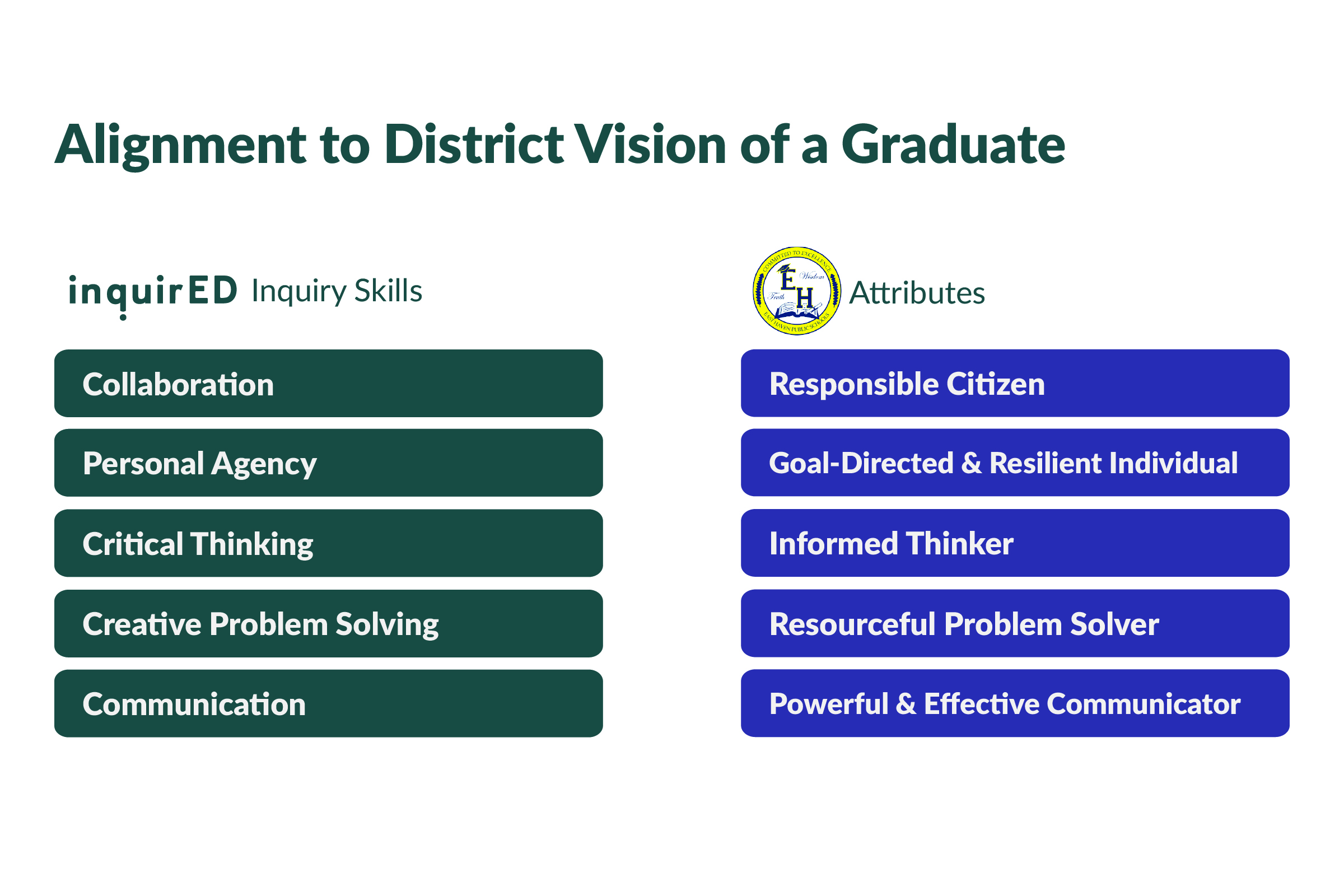
That vision directly shaped how leaders thought about social studies instruction. Swinney explained that the district’s graduate attributes provided clear instructional direction. “That idea of being a responsible citizen, a resourceful problem solver, an informed thinker, and having powerful and effective communication skills really gave guidance to what we wanted our instruction to be within social studies.”
{{download}}
Structure with purpose, not a script
In East Haven, the inquiry skills built into Inquiry Journeys map directly to the attributes in the district’s Vision of the Graduate. Skills like collaboration, communication, critical thinking, problem solving, and reflection are not separate goals. They are how students experience social studies every day. That alignment gave teachers a clear instructional throughline without asking them to give up professional judgment.
Teachers felt that balance in practice. As Swinney shared, “Teachers appreciated that there was clear guidance, but it still honored the decision-making they need to do in real time with their students.” The curriculum provided consistent routines for questioning, discourse, and analysis, while leaving room for teachers to respond to their students’ thinking in the moment.
For district leaders, the value went beyond individual lessons. Inquiry skills created shared routines students could carry across the school day and across grade levels. “We wanted students to learn routines in social studies that could translate to other areas of the day and increase authentic engagement,” Swinney explained. Over time, those routines made graduate attributes like effective communication and informed thinking visible in more than one classroom or subject.
That clarity helped preserve the integrity of both the model and the vision. “We want to think about the integrity of the model and the vision. It’s not necessarily about teaching from cover to cover,” Swinney noted. Leaders were also drawn to how inquiry builds toward informed action. As Swinney shared, “We were very attracted to taking that learning to action, building students’ exposure to design thinking.”
And perhaps most importantly, East Haven discovered that when inquiry skills are clear and consistent, students can engage in complex thinking much earlier than we might expect.
“We wanted students to learn routines in social studies that could translate to other areas of the day and increase authentic engagement.”
Turns out, kindergartners can do this
East Haven’s commitment to inquiry-based social studies revealed its impact with the district’s youngest learners. Kindergarten teachers began integrating inquiry routines into existing play-based learning, and students rose to the challenge.
Reflecting on what he saw in classrooms, Swinney shared, “What I love is that we’re asking so much more of our youngest learners, and they’re doing it. It’s powerful to see how they’re interacting with the curriculum and materials. It’s proving to our teachers that we can ask our students to do hard and complex things, and they’ll rise to the challenge. I couldn’t ask for anything more for our kids.”
{{testimonial-1}}
For the district, this went beyond a kindergarten success story, it also signaled system-wide coherence. If students can engage in inquiry this early, the question was no longer whether to introduce inquiry in elementary school.
From questions to action
A 4th-grade classroom offered another clear example of inquiry in action. As students investigated environmental impacts, they began connecting their learning to their own school context, noticing car exhaust drifting into their classroom during dismissal.
Swinney described how inquiry naturally situates student learning within a broader sense of responsibility. “Inquiry really invites students to reflect at the individual level, but always situates them back in the idea of community.”
Students gathered evidence, discussed perspectives, and decided to share their findings with their principal. The result was simple but powerful. Because of the students’ advocacy and partnership with school leadership, families began turning off their cars in the car line while waiting for dismissal.
This story was a natural outcome of students thinking critically and acting with purpose. They demonstrated responsible citizenship by considering the impact on their community, powerful communication by advocating respectfully to adults, and resourceful problem solving by identifying a solution grounded in their learning.
“Inquiry really invites students to reflect at the individual level, but always situates them back in the idea of community.”
What this means for other districts
East Haven Public Schools in Connecticut approached curriculum adoption as a systems-level decision, not just a curriculum purchase. Leaders intentionally aligned instruction, professional learning, and leadership practices around a shared Vision of the Graduate, using social studies as a space to make that vision visible in classrooms.
As Inquiry Journeys took hold, professional conversations across the district began to shift. Rather than centering on pacing or task completion, leaders and teachers focused more deeply on instructional impact. As Swinney explained, “We were having more conversations about the moves of the teacher and how that was impacting rigor and the experience students were having.”
Through inquiry-based social studies, East Haven has moved its Vision of the Graduate from a strategic document to a daily instructional reality. Inquiry Journeys became one way the district made communication, problem solving, collaboration, and responsible citizenship observable across K–5 classrooms.
East Haven’s story illustrates what is possible when a district leads with clarity and trust. The Vision of the Graduate set the direction. Inquiry Journeys provided structure and coherence. Teachers brought the work to life. Together, those elements created learning experiences where students consistently demonstrated the thinking, agency, and collaboration the district values, not just during social studies, but as habits that extend beyond the classroom.
Key takeaways for district leaders
- Look for a social studies curriculum that is anchored in the skills and dispositions students need to graduate ready for college, careers, and civic life, then evaluate curriculum through that lens.
- Choose materials that provide instructional structure while preserving teacher autonomy.
- Use inquiry-based social studies to connect learning to local and real-world contexts.
- Define success by evidence of student thinking, agency, and communication, not just lesson completion.
Curious how an inquiry-based approach could support your district’s goals? Inquiry Journeys, inquirED’s K–5 social studies curriculum, could be the right fit for your district.
Resources
Keep reading
.webp)
Inquiry-based social studies can support your Portrait of a Graduate
Inquiry Journeys, a K–5 social studies curriculum, could be the right fit for your district.
Start your journey
Inquiry Journeys, inquirED's K-5 social studies curriculum, engages students in inquiry-based learning, strengthens literacy skills, and supports teachers every step of the way.

“What I love is that we’re asking so much more of our youngest learners, and they’re doing it. It’s powerful to see how they’re interacting with the curriculum and materials. It’s proving to our teachers that we can ask our students to do hard and complex things, and they’ll rise to the challenge. I couldn’t ask for anything more for our kids.”
Adam Swinney
District Leader, East Haven Public Schools
“What I love is that we’re asking so much more of our youngest learners, and they’re doing it. It’s powerful to see how they’re interacting with the curriculum and materials. It’s proving to our teachers that we can ask our students to do hard and complex things, and they’ll rise to the challenge. I couldn’t ask for anything more for our kids.”
Adam Swinney
District Leader, East Haven Public Schools
inquirED supports teachers with high-quality instructional materials that make joyful, rigorous, and transferable learning possible for every student. Inkwell, our integrated core ELA and social studies elementary curriculum, brings ELA and social studies together into one coherent instructional block that builds deeper knowledge, comprehension, and literacy skills. Inquiry Journeys, our K–5 social studies curriculum, is used across the country to help students develop the deep content knowledge and inquiry skills essential for a thriving democracy,