Curriculum

Elementary

Social Studies

COMING SOON

Integrated ELA & Social Studies

inkwell-logo-white

Middle School

Social Studies

Upcoming Product webinar

Explore

inquiry journeys logo

Join inquirED this fall for Exploring Inquiry Journeys, a webinar series for school and district leaders. Each session offers practical insights and strategies from our curriculum to engage students and support teachers in inquiry-based elementary social studies.

Register
Professional Learning
Resources

Resource Collections

Downloadable guides, frameworks, and tools designed to help district leaders take action on social studies curriculum and instruction. Looking for our most downloaded resesources? Check the quick links below.

Curiculum Review Guide

Literacy in Social Studies Rubric

Social Studies Pacing Guide

Blog

Fresh ideas, research, and reflections to help district leaders stay sharp and responsive in an evolving social studies landscape.

Webinars

Real-time conversations and on-demand learning with experts and district leaders tackling challenges in social studies education.

NCSS & inquirED

Product Webinars

Webinar Library

free resource

Social Studies Curriculum Review Guide

Download this free tool designed to help educators, districts, and curriculum developers create, evaluate, and select social studies instructional materials that meet the demands of today’s classrooms.

Download
Log inContact sales
Log in
Contact sales

Contact sales

Cookie Settings

We use cookies to provide you with the best possible experience. They also allow us to analyze user behavior in order to constantly improve the website for you. See our Privacy Policy

Thank you! Your submission has been received!
Oops! Something went wrong while submitting the form.
Webinars

Making Time for Elementary Social Studies

Featured speakerS
Dr. Rachel Strang

Dr. Rachel Strang

Managing Implementation Coach, inquirED

NOTE: There is no recording for this webinar.

Oct 1, 2024
8
MIN READ
Copied!

I am the text that will be copied.

Webinars
BACK TO BLOG

Making Time for Elementary Social Studies

Oct 1, 2024
8
MIN READ
Copied!

I am the text that will be copied.

Table of Contents
H1 Heading
H2 Heading
H3 Heading
Table of Contents
H2 Heading
H3 Heading
H4 Heading

K-5 Social Studies Curriculum

illustration of kid holding question mark

Book a demo

illustration of kid holding question mark

Explore Inkwell!
K–2 integrated ELA and social studies

How can we ensure that elementary social studies receives the time and resources it deserves in our classrooms, schools, and districts? Let’s explore how we can advocate for and implement elementary social studies, using examples from district leaders who have successfully navigated these challenges.

Key Takeaways

  • Prioritizing social studies in elementary education is essential but often overlooked due to time constraints and competing academic subjects.
  • Collaboration between district leaders, teachers, and content areas is key to integrating social studies effectively.
  • High-quality instructional materials ensure social studies is taught effectively without burdening teachers with excessive preparation time.
  • Inquiry-based learning in social studies fosters deeper understanding and critical thinking, even when teachers are unfamiliar with the approach.
  • Pacing guides ensure equitable access to social studies instruction across schools while allowing flexibility for teachers to meet their students’ needs.

Strong Communities Start with Social Studies

Making time for elementary social studies isn’t just about fitting another subject into an already packed schedule—it’s about recognizing the essential role that social studies plays in shaping informed, engaged citizens. During this webinar, we explored practical strategies for prioritizing this vital subject in schools and districts. With panelists Dr. Rachel Strang (inquirED) and Courtney Leard (Washington County Public Schools), our discussion highlighted ways to overcome time constraints, integrate inquiry-based learning, and build a shared vision for social studies. The insights and strategies shared provide a blueprint for ensuring elementary social studies receives the attention it deserves.

Locus of Control

Locus of Control | Making Time for Elementary Social Studies | inquirED

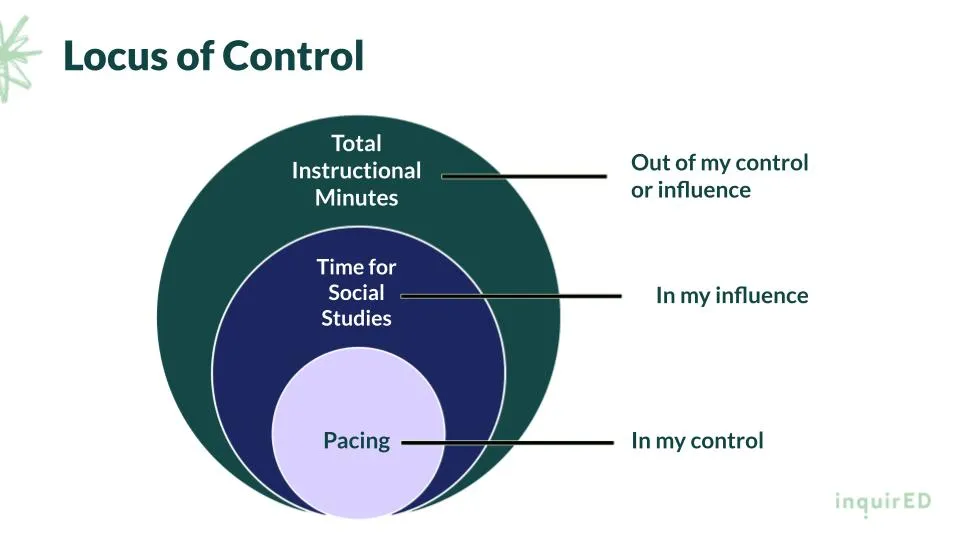
We started the webinar by asking Dr. Rachel Strang,  Managing Implementation Coach at inquirED,  about where she begins her work with district leaders, particularly how she starts conversations about making time for social studies. She often begins by discussing locus of control: “I often hear, ‘I don’t have control over how much time is allotted for social studies,’ but sometimes it feels like we don’t have control over these things. The question is, might we be able to influence them?”

Rachel shared how, in her former district, she worked with school principals to examine schedules and find space for social studies: “Rather than saying it’s the school leader’s decision, we thought, can we influence it?” She emphasized the importance of focusing on collaboration and what is possible instead of trying to change things you can’t control. “It’s about figuring out what’s within our control,” she explained, “and using that knowledge to make intentional moves forward.”

A Framework for Success

Implementing Elementary Social Stuides

To prioritize elementary social studies, we need a clear framework that focuses on what's within our control. Rachel brought a framework with her adapted from Instruction Partners, and this framework guided our conversation during the webinar. To help us understand how the framework looks in action, Courtney Leard, Elementary ELA and Social Studies Content Specialist at Washington County Public Schools, joined us. Our discussion focused on three critical elements: Vision, Time, and Process—the foundational components of a successful implementation in elementary social studies.

Vision

Promoting a vision for elementary social studies is the starting point for creating momentum. A clear, articulated vision ensures that educators and leaders understand why social studies instruction is essential, helping to align priorities across schools and districts.

Courtney shared her experience in Washington County, where they developed a unified vision for Pre-K through 12th-grade social studies instruction. This vision, she explained, was created collaboratively with teachers from all grade levels and community members:

"All WCPS students have the right to expand their understanding of the world, its people, and themselves. Instruction, grounded in content knowledge and critical-thinking skills, empowers confident and informed students to address questions, form opinions, and solve problems relevant to their role as citizens in a global society.

The vision emphasizes the importance of allowing every student to engage meaningfully with social studies.  As Courtney noted, the process of developing the vision was intensive: "It was a 3-hour process all day of really us working, you know, what should be in there, what shouldn’t be in there from all stakeholders and all perspectives."

This vision is not only a guiding principle for instruction but also a commitment to ensuring that social studies is given the space and importance it deserves in the curriculum. Courtney emphasized: "Every student here has the right to be able to learn and engage in instruction and critical thinking." Rachel reinforced the idea that a strong vision is more than just a statement: "When you have a vision that is so powerfully built... everything tracks back to it – it helps you move forward."

Time

Time remains one of the biggest challenges for elementary social studies instruction. As Rachel explained: "When I meet with district leaders, instructional time is probably the number one issue. There’s just not enough minutes in the day."

Finding time for social studies in elementary schedules often means competing with other subjects like ELA and math. In response to this challenge, Courtney emphasized the importance of collaboration between subjects to make the most of the time available. She explained how her district began looking for connections between subjects, specifically between social studies and science: "Our science is inquiry-based. Our social studies is inquiry-based. There are connections there."

Instead of seeing subjects as competing for instructional time, her district focused on how they could complement each other. Courtney noted:

"We can all choose to fight and hold on to our times, or we can figure out a way to collaborate and really come together."

By working together, Courtney and her team were able to find opportunities for overlap, where students could build skills and knowledge across disciplines. This approach not only maximized the limited time available but also enriched the learning experience: "When we really did that, we found all those ways that the standards can support each other. It’s a win-win situation."

Courtney also pointed out that working across subjects has another benefit: reducing teacher workload and supporting better planning. By coordinating lessons between science and social studies, teachers only need to plan for one at a time, which eases the pressure on them:

"If they're only planning for one at a time, they don't have to go back and forth and switch on and off for that planning piece."

This collaborative approach allows districts to creatively address time constraints while ensuring that social studies remains a key part of the curriculum.

Process

An intentional process for reviewing, adopting, and implementing social studies is critical for long-term success. Rachel shared her experience as a district leader, where her initial focus was simply on getting social studies into the curriculum:

"We adopted a curriculum and I thought we could just implement it... but what I ran into was, I didn’t really have the buy-in. I didn’t really have an intentional process."

Without a clear process, even the best curriculum can face resistance from teachers and administrators. This is why it's essential to have a structured and thoughtful approach that involves all stakeholders—from district leaders to teachers—to ensure smooth implementation and success.

Courtney shared a similar experience from her district, where they transitioned from a traditional, recall-based social studies curriculum to one focused on inquiry-based learning. She explained how moving beyond rote memorization created a more engaging and meaningful experience for students: "Before, it was recall... Now, we really work for students to have some type of application in action. If you’re not doing something with the social studies, then why are we doing it?"

This shift required not only updating instructional materials but also ensuring teachers were fully on board and supported. Courtney highlighted the importance of collaboration and alignment among all levels of leadership and teaching staff:

"We had to figure out how to create a process that makes sense for everyone and ensures equity in education."

Central to this process was clear communication, as Courtney described how they leaned on data and research to help build trust: "We leaned into the research... There’s so much research out there, and we leaned into that with admin, with principals, and with other county-level folks who were making those decisions."

Pacing

Pacing is a crucial element in ensuring that all students receive an equitable and consistent education in social studies. Courtney’s experience in Washington County provided insight into how effective pacing supports student learning and teacher flexibility. She explained that in a district with more than 20 different elementary schools, pacing ensures that every student has access to the same high-quality education, regardless of their location: "Pacing ensures equity of education... It ensures that every child in my 26 different elementary schools has access to the same high-quality content and instruction."

Pacing guides help maintain consistency across classrooms, ensuring that teachers don’t fall behind on critical content. However, Courtney was clear that pacing is not about rigid timelines: "I’m not ever going to be a pacing police officer... You know your students. If that means you need to spend two days on a lesson, then you need to do that." The key, she explained, is to balance flexibility with the responsibility to cover essential content so that no students are left behind. Teachers are encouraged to adjust their pacing when necessary, but they must remain aware of the larger goals for the unit: "It’s not about day-to-day. It’s really about, ‘Hey, these are the big ideas that our students have to walk away with.’"

{{download}}

Rachel agreed that pacing can be challenging, particularly in the early stages of implementing a new curriculum. In her experience, flexibility is key, and teachers need support as they learn to balance inquiry-based instruction with pacing requirements. She suggested that during the first year of implementation, it might be necessary to focus on fewer units to ensure a deep understanding of the material, rather than trying to rush through everything.

Courtney reinforced this point, explaining that their district’s approach to pacing helps alleviate some of the pressure on teachers: "If they're only planning for one subject at a time, they don’t have to go back and forth and switch on and off. It helps them focus and makes the whole process smoother."

By creating a pacing system that allows for flexibility but ensures essential content is covered, districts can provide both structure and autonomy to teachers, while maintaining equity for students. This ensures that all students, regardless of the classroom they’re in, receive a well-rounded and thorough social studies education.

Time for Elementary Social Studies: A Difference Maker

In this webinar, we explored the essential elements needed to prioritize elementary social studies—vision, time, and process. Both Rachel Strang and Courtney Leard provided valuable insights into how districts can successfully implement inquiry-based social studies, while also addressing the challenges of time constraints and gaining buy-in from all stakeholders. By focusing on a clear vision, collaborating across subjects, and following a structured process, schools can ensure that social studies remains a vital part of the curriculum.

To access more resources and tools that support implementation, explore the materials below, and don’t forget to watch the full webinar recording to dive deeper into the strategies and solutions discussed.

Strong Communities Start with Social Studies

Making time for elementary social studies isn’t just about fitting another subject into an already packed schedule—it’s about recognizing the essential role that social studies plays in shaping informed, engaged citizens. During this webinar, we explored practical strategies for prioritizing this vital subject in schools and districts. With panelists Dr. Rachel Strang (inquirED) and Courtney Leard (Washington County Public Schools), our discussion highlighted ways to overcome time constraints, integrate inquiry-based learning, and build a shared vision for social studies. The insights and strategies shared provide a blueprint for ensuring elementary social studies receives the attention it deserves.

Locus of Control

Locus of Control | Making Time for Elementary Social Studies | inquirED

We started the webinar by asking Dr. Rachel Strang,  Managing Implementation Coach at inquirED,  about where she begins her work with district leaders, particularly how she starts conversations about making time for social studies. She often begins by discussing locus of control: “I often hear, ‘I don’t have control over how much time is allotted for social studies,’ but sometimes it feels like we don’t have control over these things. The question is, might we be able to influence them?”

Rachel shared how, in her former district, she worked with school principals to examine schedules and find space for social studies: “Rather than saying it’s the school leader’s decision, we thought, can we influence it?” She emphasized the importance of focusing on collaboration and what is possible instead of trying to change things you can’t control. “It’s about figuring out what’s within our control,” she explained, “and using that knowledge to make intentional moves forward.”

A Framework for Success
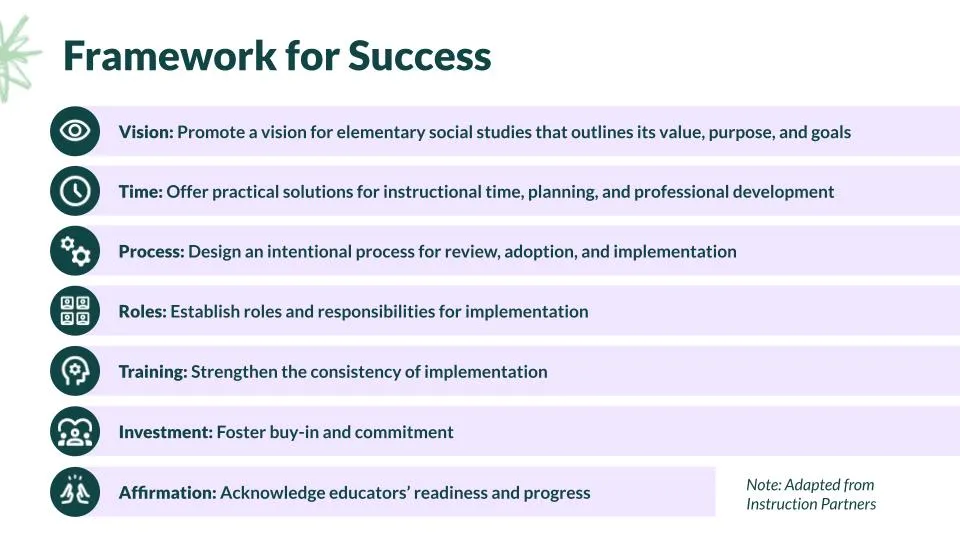
Implementing Elementary Social Stuides

To prioritize elementary social studies, we need a clear framework that focuses on what's within our control. Rachel brought a framework with her adapted from Instruction Partners, and this framework guided our conversation during the webinar. To help us understand how the framework looks in action, Courtney Leard, Elementary ELA and Social Studies Content Specialist at Washington County Public Schools, joined us. Our discussion focused on three critical elements: Vision, Time, and Process—the foundational components of a successful implementation in elementary social studies.

Vision

Promoting a vision for elementary social studies is the starting point for creating momentum. A clear, articulated vision ensures that educators and leaders understand why social studies instruction is essential, helping to align priorities across schools and districts.

Courtney shared her experience in Washington County, where they developed a unified vision for Pre-K through 12th-grade social studies instruction. This vision, she explained, was created collaboratively with teachers from all grade levels and community members:

"All WCPS students have the right to expand their understanding of the world, its people, and themselves. Instruction, grounded in content knowledge and critical-thinking skills, empowers confident and informed students to address questions, form opinions, and solve problems relevant to their role as citizens in a global society.

The vision emphasizes the importance of allowing every student to engage meaningfully with social studies.  As Courtney noted, the process of developing the vision was intensive: "It was a 3-hour process all day of really us working, you know, what should be in there, what shouldn’t be in there from all stakeholders and all perspectives."

This vision is not only a guiding principle for instruction but also a commitment to ensuring that social studies is given the space and importance it deserves in the curriculum. Courtney emphasized: "Every student here has the right to be able to learn and engage in instruction and critical thinking." Rachel reinforced the idea that a strong vision is more than just a statement: "When you have a vision that is so powerfully built... everything tracks back to it – it helps you move forward."

Time

Time remains one of the biggest challenges for elementary social studies instruction. As Rachel explained: "When I meet with district leaders, instructional time is probably the number one issue. There’s just not enough minutes in the day."

Finding time for social studies in elementary schedules often means competing with other subjects like ELA and math. In response to this challenge, Courtney emphasized the importance of collaboration between subjects to make the most of the time available. She explained how her district began looking for connections between subjects, specifically between social studies and science: "Our science is inquiry-based. Our social studies is inquiry-based. There are connections there."

Instead of seeing subjects as competing for instructional time, her district focused on how they could complement each other. Courtney noted:

"We can all choose to fight and hold on to our times, or we can figure out a way to collaborate and really come together."

By working together, Courtney and her team were able to find opportunities for overlap, where students could build skills and knowledge across disciplines. This approach not only maximized the limited time available but also enriched the learning experience: "When we really did that, we found all those ways that the standards can support each other. It’s a win-win situation."

Courtney also pointed out that working across subjects has another benefit: reducing teacher workload and supporting better planning. By coordinating lessons between science and social studies, teachers only need to plan for one at a time, which eases the pressure on them:

"If they're only planning for one at a time, they don't have to go back and forth and switch on and off for that planning piece."

This collaborative approach allows districts to creatively address time constraints while ensuring that social studies remains a key part of the curriculum.

Process

An intentional process for reviewing, adopting, and implementing social studies is critical for long-term success. Rachel shared her experience as a district leader, where her initial focus was simply on getting social studies into the curriculum:

"We adopted a curriculum and I thought we could just implement it... but what I ran into was, I didn’t really have the buy-in. I didn’t really have an intentional process."

Without a clear process, even the best curriculum can face resistance from teachers and administrators. This is why it's essential to have a structured and thoughtful approach that involves all stakeholders—from district leaders to teachers—to ensure smooth implementation and success.

Courtney shared a similar experience from her district, where they transitioned from a traditional, recall-based social studies curriculum to one focused on inquiry-based learning. She explained how moving beyond rote memorization created a more engaging and meaningful experience for students: "Before, it was recall... Now, we really work for students to have some type of application in action. If you’re not doing something with the social studies, then why are we doing it?"

This shift required not only updating instructional materials but also ensuring teachers were fully on board and supported. Courtney highlighted the importance of collaboration and alignment among all levels of leadership and teaching staff:

"We had to figure out how to create a process that makes sense for everyone and ensures equity in education."

Central to this process was clear communication, as Courtney described how they leaned on data and research to help build trust: "We leaned into the research... There’s so much research out there, and we leaned into that with admin, with principals, and with other county-level folks who were making those decisions."

Pacing

Pacing is a crucial element in ensuring that all students receive an equitable and consistent education in social studies. Courtney’s experience in Washington County provided insight into how effective pacing supports student learning and teacher flexibility. She explained that in a district with more than 20 different elementary schools, pacing ensures that every student has access to the same high-quality education, regardless of their location: "Pacing ensures equity of education... It ensures that every child in my 26 different elementary schools has access to the same high-quality content and instruction."

Pacing guides help maintain consistency across classrooms, ensuring that teachers don’t fall behind on critical content. However, Courtney was clear that pacing is not about rigid timelines: "I’m not ever going to be a pacing police officer... You know your students. If that means you need to spend two days on a lesson, then you need to do that." The key, she explained, is to balance flexibility with the responsibility to cover essential content so that no students are left behind. Teachers are encouraged to adjust their pacing when necessary, but they must remain aware of the larger goals for the unit: "It’s not about day-to-day. It’s really about, ‘Hey, these are the big ideas that our students have to walk away with.’"

{{download}}

Rachel agreed that pacing can be challenging, particularly in the early stages of implementing a new curriculum. In her experience, flexibility is key, and teachers need support as they learn to balance inquiry-based instruction with pacing requirements. She suggested that during the first year of implementation, it might be necessary to focus on fewer units to ensure a deep understanding of the material, rather than trying to rush through everything.

Courtney reinforced this point, explaining that their district’s approach to pacing helps alleviate some of the pressure on teachers: "If they're only planning for one subject at a time, they don’t have to go back and forth and switch on and off. It helps them focus and makes the whole process smoother."

By creating a pacing system that allows for flexibility but ensures essential content is covered, districts can provide both structure and autonomy to teachers, while maintaining equity for students. This ensures that all students, regardless of the classroom they’re in, receive a well-rounded and thorough social studies education.

Time for Elementary Social Studies: A Difference Maker

In this webinar, we explored the essential elements needed to prioritize elementary social studies—vision, time, and process. Both Rachel Strang and Courtney Leard provided valuable insights into how districts can successfully implement inquiry-based social studies, while also addressing the challenges of time constraints and gaining buy-in from all stakeholders. By focusing on a clear vision, collaborating across subjects, and following a structured process, schools can ensure that social studies remains a vital part of the curriculum.

To access more resources and tools that support implementation, explore the materials below, and don’t forget to watch the full webinar recording to dive deeper into the strategies and solutions discussed.

Watch the recording

Resources

From inquirED

  • Pacing Guide
  • High-Quality Instructional Materials in Social Studies, Review Guide

From Courtney Leard

  • Elementary Master Schedule recommendations
  • All contents At A Glance
  • Grade 1 Pacing Support
  • Grade 4 Pacing Support

Keep reading

Name

previous

Name

Next

Writing for Meaning and Understanding: The Power of Integrated ELA and Social Studies

Deeper Knowledge and Comprehension Through ELA and Social Studies Integration

The Cognitive Load Problem: Why Too Many Programs Undermine Learning

The Elementary Time Problem: Too Much to Teach, Too Little Time

Canby Brings Oregon’s Vision for Social Science Education to Life

How Standards-Based Inquiry Sparked Innovation in Iowa City Community School District

How West Aurora Turned Social Science into Literacy Gains

Discourse and Differentiation: A Day in the Life of Inquiry in a 5th-Grade Classroom

Implementing Elementary Social Studies Across a District

The Missing Piece in Reading Comprehension: Social Studies

How SFUSD Brought Inquiry-Based Social Studies to Life

Culturally Responsive Education in Social Studies

How to Choose a High-Quality Elementary Social Studies Curriculum

Exploring the Inquiry Journeys Logic Model

How Oconomowoc made standards stick

Creative ways districts are making time for K-5 social studies

Your Guide to Meaningful Inquiry Walls in the Classroom

Using Inquiry in Elementary Social Studies

Think-Pair-Share | Inquiry Lesson Plan Strategy

Social Studies Projects: Give Students the Keys to Success

Can Curriculum-Based Professional Learning Transform Teaching?

Predict Learn Conclude | Inquiry Lesson Plan Strategy

Literacy in Social Studies: Layered Learning with Primary and Secondary Sources

Inquiry Journeys: Literacy Practices and Supports

Inquiry in Action: Classroom Spotlights

Creating a Roadmap for Social Studies Curriculum Review and Adoption

Wisconsin Makes The Case For Elementary Social Studies

"Yes, And..." | Inquiry Lesson Plan Strategy

Why Inquiry-Based Social Studies Matters in K–5 Classrooms

Elementary Social Studies | What is Informed Action?

What is Inquiry-Based Social Studies?

Inquiry in Social Studies Classrooms

What is the best inquiry process for elementary social studies curriculum?

Using Content-Area Literacy Strategies in Social Studies Instruction

Supporting the Shift to Inquiry

Keeping Curiosity Alive

Up to the Task: How to Support Student-Led Learning in Elementary Social Studies

Integrating SEL and Social Studies

Teaching in an Election Season: Rights and Responsibilities

Tell Me More: Using Diverse Books and Inquiry to Teach History

Voice and Choice in Inquiry-Based Learning

Using Primary Sources from the Library of Congress through Distance Learning

Un-level That Text! Integrating Literacy and Elementary Social Studies

Tools for Identifying High-Quality Social Studies Instruction

Time to Design: inquirED's Elementary Social Studies Curriculum Supports Teachers

The State of K-8 Social Studies

Bringing Learning to Life: The Power of Informed Action in Social Studies

The Social Studies ELA Connection: Making the Case For Elementary Social Studies

Theory to Practice: Implementing High-Quality Instruction

The Future of Social Studies: Webinar Series Launch

The Steps Toward Inquiry in Social Studies (Series Launch)

The Power of High-Quality Instructional Materials

Media Literacy: Making The Case For Elementary Social Studies

Social Studies in the Age of Disinformation: Making the Case For Elementary Social Studies

Storytime in Social Studies: Using Picture Books Across an Inquiry

Making the Case For Elementary Social Studies: District Leaders

Building Deep Background Knowledge: Making The Case For Elementary Social Studies

High-Quality Instructional Materials in Social Studies

Socratic Seminar | Inquiry Lesson Plan Strategy

Seen, Shared, Shaped Over Time: Making Learning Visible in Social Studies

The Social Studies Curriculum Review Guide

See Think Wonder | Inquiry Lesson Plan Strategy

Searching for Social Studies: Denver Public Schools

Media Literacy: Primary and Secondary Sources in Inquiry Journeys

Social Studies Curriculum Review and Adoption

Schema Building and Knowledge Transfer

Questioning: The Key to Unlocking the Power of Inquiry in Social Studies

What are your district's priorities for curriculum review and adoption?

Picture Walks and Other Pre-Reading Strategies for Early Literacy Development

Multimodal Learning in Inquiry Journeys

New Standards, New Directions: When Your State Goes All-In for Inquiry

Note Card Reflection | Inquiry Lesson Plan Strategy

Making Time for Elementary Social Studies

Layers of Meaning: Knowledge Building and Complex Texts

Sources as Mirrors and Windows: Making the Case for Elementary Social Studies

Mingle Pair Share | Inquiry Lesson Plan Strategy

Making the Case for Elementary Social Studies

Civic Life in the Era of Truth Decay: Making the Case for Elementary Social Studies

Inquiry Unit Design

Why Inquiry Skills Matter in K–5 Social Studies Classrooms

Inquiry Journeys: Elementary Social Studies Curriculum Resources

Inquiry vs. Knowledge Building: Dismantling the False Dichotomy

Inquiry-Based Elementary Social Studies and the C3 Framework

Inquiry Advocates: Partners with inquirED

Inquiry-Based Elementary Social Studies and the Common Core

Informed Action in Inquiry Journeys: A Garden Grows in Ohio

Inquiry-Based Learning: Research

inquirED's 21st Century Skills

Inquiry-Based Elementary Social Studies and the CASEL Competencies

Implementing Elementary Social Studies: Best Practices from District Leaders

Idea Clustering | Inquiry Lesson Plan Strategy

I Like, I Wonder | Inquiry Lesson Plan Strategy

Hexagonal Thinking & Mapping: A Dynamic Strategy for Deeper Learning

Group Roles | Inquiry Lesson Plan Strategy

Exploration and Meaning Making: Social Studies in K-2 Classrooms

Give an Inquiry-Based Learning Shout Out!

Creating an Inquiry-Based Learning Culture in Elementary Social Studies

Formative Assessments: Exit Tickets

Exploring the Lasting Power of Stories

Civic Engagement: What Can a Citizen Do? Interview with Dave Eggers and Shawn Harris

See more of this series

Division to Dialogue: Teaching Social Studies in Polarizing Times

Sep 8, 2024
5
MIN READ

Building a Culture of Discussion in Social Studies Classrooms

Oct 29, 2024
4
MIN READ

52 Words: The Meaning and Message of the Preamble

Dec 8, 2024
6
MIN READ

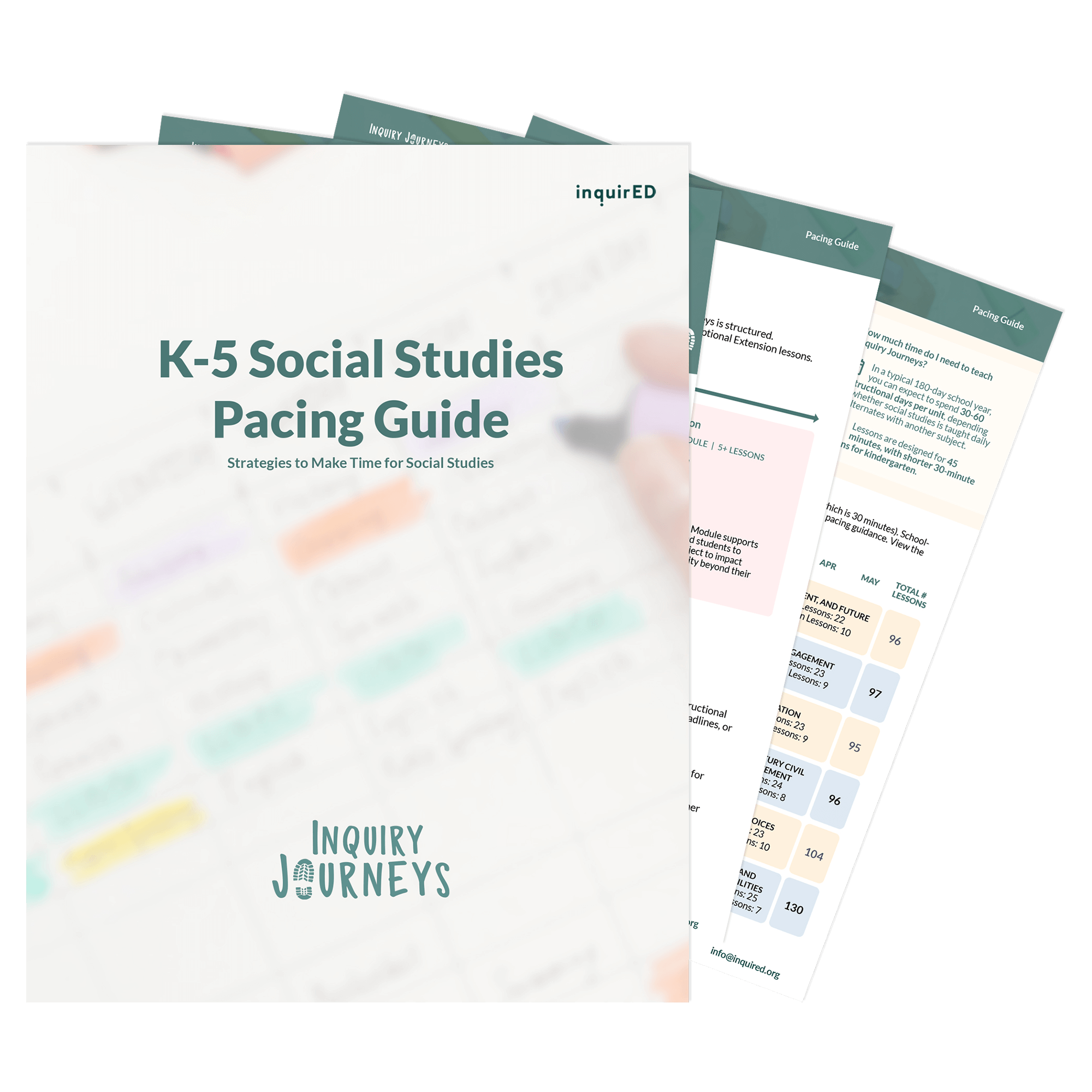
Download pacing guide

Want to view a sample pacing guide from Inquiry Journeys, inquirED’s elementary social studies curriculum?

Download now

Start your journey

Inquiry Journeys, inquirED's K-5 social studies curriculum, engages students in inquiry-based learning, strengthens literacy skills, and supports teachers every step of the way.

Get in touch
illustration of kid holding question mark

No items found.

inquirED supports teachers with high-quality instructional materials that make joyful, rigorous, and transferable learning possible for every student. Inkwell, our integrated core ELA and social studies elementary curriculum, brings ELA and social studies together into one coherent instructional block that builds deeper knowledge, comprehension, and literacy skills. Inquiry Journeys, our K–5 social studies curriculum, is used across the country to help students develop the deep content knowledge and inquiry skills essential for a thriving democracy,

Copied!

I am the text that will be copied.

Webinars

Subscribe to receive email updates from inquirED

Related posts

See all resources

Webinars

Discourse and Differentiation: A Day in the Life of Inquiry in a 5th-Grade Classroom

Dec 16, 2025
7
MIN READ

Webinars

Implementing Elementary Social Studies Across a District

Oct 23, 2025
7
MIN READ

Webinars

High-Quality Instructional Materials in Social Studies

Oct 23, 2025
5
MIN READ
See all resources

Contact us

Contact sales

Ready to learn more?

Connect with someone from the inquirED team to schedule a demo or learn more about our products.

Connect with us

Want the latest webinars, resources, and tools? Sign up for inquirED’s newsletter.

About inquirED

About UsOur TeamCareers

Get in touch

SalesGeneral Inquiries

Social

LinkedIn
Instagram
Facebook
YouTube

© {year} inquirED Inc.. All rights reserved.

Data + Security
|
Privacy Policy
|
Terms and Conditions