Curriculum

Elementary

Social Studies

COMING SOON

Integrated ELA & Social Studies

inkwell-logo-white

Middle School

Social Studies

Upcoming Product webinar

Explore

inquiry journeys logo

Join inquirED this fall for Exploring Inquiry Journeys, a webinar series for school and district leaders. Each session offers practical insights and strategies from our curriculum to engage students and support teachers in inquiry-based elementary social studies.

Register
Professional Learning
Resources

Resource Collections

Downloadable guides, frameworks, and tools designed to help district leaders take action on social studies curriculum and instruction. Looking for our most downloaded resesources? Check the quick links below.

Curiculum Review Guide

Literacy in Social Studies Rubric

Social Studies Pacing Guide

Blog

Fresh ideas, research, and reflections to help district leaders stay sharp and responsive in an evolving social studies landscape.

Webinars

Real-time conversations and on-demand learning with experts and district leaders tackling challenges in social studies education.

NCSS & inquirED

Product Webinars

Webinar Library

free resource

Social Studies Curriculum Review Guide

Download this free tool designed to help educators, districts, and curriculum developers create, evaluate, and select social studies instructional materials that meet the demands of today’s classrooms.

Download
Log inContact sales
Log in
Contact sales

Contact sales

Cookie Settings

We use cookies to provide you with the best possible experience. They also allow us to analyze user behavior in order to constantly improve the website for you. See our Privacy Policy

Thank you! Your submission has been received!
Oops! Something went wrong while submitting the form.
Elementary Social Studies

Elementary Social Studies | What is Informed Action?

Featured speakerS
No items found.

NOTE: There is no recording for this webinar.

Nov 2, 2020
3
MIN READ
Copied!

I am the text that will be copied.

Elementary Social Studies
BACK TO BLOG

Elementary Social Studies | What is Informed Action?

inquirED

Nov 2, 2020
3
MIN READ
Copied!

I am the text that will be copied.

Table of Contents
H1 Heading
H2 Heading
H3 Heading
Table of Contents
H2 Heading
H3 Heading
H4 Heading

K-5 Social Studies Curriculum

illustration of kid holding question mark

Book a demo

illustration of kid holding question mark

Explore Inkwell!
K–2 integrated ELA and social studies

Key Takeaways

The Shift Towards Inquiry in Elementary Social Studies

There has been a tremendous movement towards using inquiry in elementary social studies curriculum and instruction thanks to the College, Career, and Civic Life (C3) Framework.

The C3 Framework is an innovative approach to social studies instruction that emphasizes inquiry-driven learning. The framework divides the inquiry process into four key dimensions:

  1. Dimension 1: Developing questions and planning inquiries.
  2. Dimension 2: Applying disciplinary concepts and tools.
  3. Dimension 3: Evaluating sources and using evidence.
  4. Dimension 4: Communicating conclusions and taking informed action.

It's important to note that inquiry isn't only about skills – it's also focused on deep knowledge building. While the process of inquiry equips students with critical thinking and analytical abilities, the social studies knowledge they build through sustained investigation is deeper and more connected.

Aligning inquirED's Inquiry Journeys with the C3 Framework
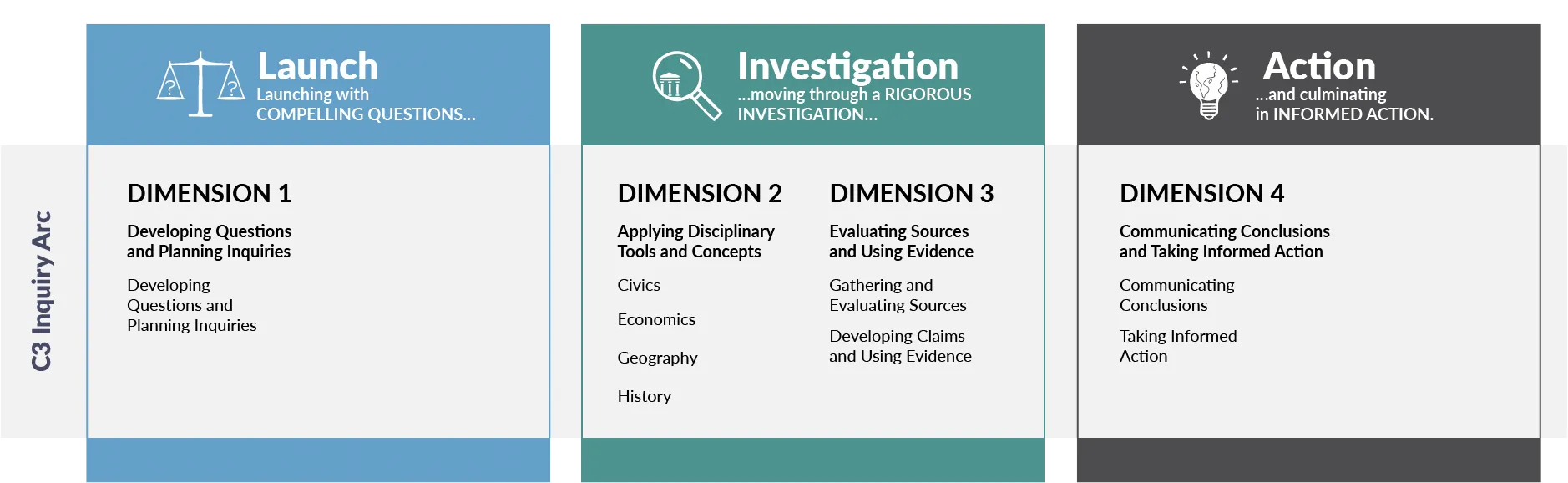
inquirED's Unit Structure & the C3 Inquiry Arc

Inquiry Journeys, inquirED's elementary social studies curriculum, is intricately crafted around the principles of the C3 Framework:

  • Launch (Dimension 1): This phase is all about sparking curiosity. It involves developing essential questions that guide the entire inquiry process.
  • Investigation (Dimensions 2 & 3): During this phase, students dive deep into the content, applying disciplinary concepts, evaluating sources, and gathering evidence.
  • Action (Dimension 4): This final phase is where students use their findings to communicate their conclusions and take informed actions that make a real-world impact.

Find out more about the connections between Inquiry Journeys and the C3 Framework.

A Deep Dive into Dimension 4: Taking Informed Action.

Dimension four of the C3 Framework requires students to communicate and critique conclusions — and take informed action. Specifically, we will discuss how inquirED defines informed action.

Students take Informed Action when they use the key findings from a sustained investigation of content to design and implement an action that impacts the world in a meaningful way. Informed Action serves a purpose beyond assessing what students know or don't know — it helps students transform their content knowledge into action and connect it with their lived experience.

Informed action requires students to use what they've learned to inspire, change behaviors, solve a problem, or serve an audience.

Sweet Spot of Informed Action | inquirED

We like to use the Venn Diagram above when we talk about informed action, because it displays how Informed Action is the "sweet spot" between just "being informed" and just "taking action" When students are in that sweet spot, the challenge, purpose, and audience of student action come together to create meaning and deepen learning.

If students are only informed during an inquiry, they might pursue an Inquiry Question, but only be challenged to show their understanding to their teacher for a letter grade on a test or deliverable.  And if students only take action, then their challenge might be limited to participating in an activity that’s vaguely related to their learning, even if they are addressing a public audience.

It’s not that there’s no purpose for a test, stand-alone project, or activity; during an inquiry, they can serve a valuable purpose to assess learning, engage students, and check for understanding. But these can’t be the point of an inquiry.

When an inquiry promotes informed action, however, the point becomes clear and resonates with students. They identify a challenge that is informed by their learning and addresses a real-world problem—one that matters to their community and connects to their lived experience. Their audience and impact is outside the classroom as well, whether it’s students in a different grade or outside their school building. While they may receive a grade, the grade isn’t the point of their action. Students are trying to have an authentic impact on the world.

The real-world connection is powerful, making learning more engaging, and content more memorable.

The Shift Towards Inquiry in Elementary Social Studies

There has been a tremendous movement towards using inquiry in elementary social studies curriculum and instruction thanks to the College, Career, and Civic Life (C3) Framework.

The C3 Framework is an innovative approach to social studies instruction that emphasizes inquiry-driven learning. The framework divides the inquiry process into four key dimensions:

  1. Dimension 1: Developing questions and planning inquiries.
  2. Dimension 2: Applying disciplinary concepts and tools.
  3. Dimension 3: Evaluating sources and using evidence.
  4. Dimension 4: Communicating conclusions and taking informed action.

It's important to note that inquiry isn't only about skills – it's also focused on deep knowledge building. While the process of inquiry equips students with critical thinking and analytical abilities, the social studies knowledge they build through sustained investigation is deeper and more connected.

Aligning inquirED's Inquiry Journeys with the C3 Framework

inquirED's Unit Structure & the C3 Inquiry Arc

Inquiry Journeys, inquirED's elementary social studies curriculum, is intricately crafted around the principles of the C3 Framework:

  • Launch (Dimension 1): This phase is all about sparking curiosity. It involves developing essential questions that guide the entire inquiry process.
  • Investigation (Dimensions 2 & 3): During this phase, students dive deep into the content, applying disciplinary concepts, evaluating sources, and gathering evidence.
  • Action (Dimension 4): This final phase is where students use their findings to communicate their conclusions and take informed actions that make a real-world impact.

Find out more about the connections between Inquiry Journeys and the C3 Framework.

A Deep Dive into Dimension 4: Taking Informed Action.

Dimension four of the C3 Framework requires students to communicate and critique conclusions — and take informed action. Specifically, we will discuss how inquirED defines informed action.

Students take Informed Action when they use the key findings from a sustained investigation of content to design and implement an action that impacts the world in a meaningful way. Informed Action serves a purpose beyond assessing what students know or don't know — it helps students transform their content knowledge into action and connect it with their lived experience.

Informed action requires students to use what they've learned to inspire, change behaviors, solve a problem, or serve an audience.

Sweet Spot of Informed Action | inquirED

We like to use the Venn Diagram above when we talk about informed action, because it displays how Informed Action is the "sweet spot" between just "being informed" and just "taking action" When students are in that sweet spot, the challenge, purpose, and audience of student action come together to create meaning and deepen learning.

If students are only informed during an inquiry, they might pursue an Inquiry Question, but only be challenged to show their understanding to their teacher for a letter grade on a test or deliverable.  And if students only take action, then their challenge might be limited to participating in an activity that’s vaguely related to their learning, even if they are addressing a public audience.

It’s not that there’s no purpose for a test, stand-alone project, or activity; during an inquiry, they can serve a valuable purpose to assess learning, engage students, and check for understanding. But these can’t be the point of an inquiry.

When an inquiry promotes informed action, however, the point becomes clear and resonates with students. They identify a challenge that is informed by their learning and addresses a real-world problem—one that matters to their community and connects to their lived experience. Their audience and impact is outside the classroom as well, whether it’s students in a different grade or outside their school building. While they may receive a grade, the grade isn’t the point of their action. Students are trying to have an authentic impact on the world.

The real-world connection is powerful, making learning more engaging, and content more memorable.

Watch the recording

Resources

Keep reading

Name

previous

Name

Next

Writing for Meaning and Understanding: The Power of Integrated ELA and Social Studies

Deeper Knowledge and Comprehension Through ELA and Social Studies Integration

The Cognitive Load Problem: Why Too Many Programs Undermine Learning

The Elementary Time Problem: Too Much to Teach, Too Little Time

Canby Brings Oregon’s Vision for Social Science Education to Life

How Standards-Based Inquiry Sparked Innovation in Iowa City Community School District

How West Aurora Turned Social Science into Literacy Gains

Discourse and Differentiation: A Day in the Life of Inquiry in a 5th-Grade Classroom

Implementing Elementary Social Studies Across a District

The Missing Piece in Reading Comprehension: Social Studies

How SFUSD Brought Inquiry-Based Social Studies to Life

Culturally Responsive Education in Social Studies

How to Choose a High-Quality Elementary Social Studies Curriculum

Exploring the Inquiry Journeys Logic Model

How Oconomowoc made standards stick

Creative ways districts are making time for K-5 social studies

Your Guide to Meaningful Inquiry Walls in the Classroom

Using Inquiry in Elementary Social Studies

Think-Pair-Share | Inquiry Lesson Plan Strategy

Social Studies Projects: Give Students the Keys to Success

Can Curriculum-Based Professional Learning Transform Teaching?

Predict Learn Conclude | Inquiry Lesson Plan Strategy

Literacy in Social Studies: Layered Learning with Primary and Secondary Sources

Inquiry Journeys: Literacy Practices and Supports

Inquiry in Action: Classroom Spotlights

Creating a Roadmap for Social Studies Curriculum Review and Adoption

Wisconsin Makes The Case For Elementary Social Studies

"Yes, And..." | Inquiry Lesson Plan Strategy

Why Inquiry-Based Social Studies Matters in K–5 Classrooms

Elementary Social Studies | What is Informed Action?

What is Inquiry-Based Social Studies?

Inquiry in Social Studies Classrooms

What is the best inquiry process for elementary social studies curriculum?

Using Content-Area Literacy Strategies in Social Studies Instruction

Supporting the Shift to Inquiry

Keeping Curiosity Alive

Up to the Task: How to Support Student-Led Learning in Elementary Social Studies

Integrating SEL and Social Studies

Teaching in an Election Season: Rights and Responsibilities

Tell Me More: Using Diverse Books and Inquiry to Teach History

Voice and Choice in Inquiry-Based Learning

Using Primary Sources from the Library of Congress through Distance Learning

Un-level That Text! Integrating Literacy and Elementary Social Studies

Tools for Identifying High-Quality Social Studies Instruction

Time to Design: inquirED's Elementary Social Studies Curriculum Supports Teachers

The State of K-8 Social Studies

Bringing Learning to Life: The Power of Informed Action in Social Studies

The Social Studies ELA Connection: Making the Case For Elementary Social Studies

Theory to Practice: Implementing High-Quality Instruction

The Future of Social Studies: Webinar Series Launch

The Steps Toward Inquiry in Social Studies (Series Launch)

The Power of High-Quality Instructional Materials

Media Literacy: Making The Case For Elementary Social Studies

Social Studies in the Age of Disinformation: Making the Case For Elementary Social Studies

Storytime in Social Studies: Using Picture Books Across an Inquiry

Making the Case For Elementary Social Studies: District Leaders

Building Deep Background Knowledge: Making The Case For Elementary Social Studies

High-Quality Instructional Materials in Social Studies

Socratic Seminar | Inquiry Lesson Plan Strategy

Seen, Shared, Shaped Over Time: Making Learning Visible in Social Studies

The Social Studies Curriculum Review Guide

See Think Wonder | Inquiry Lesson Plan Strategy

Searching for Social Studies: Denver Public Schools

Media Literacy: Primary and Secondary Sources in Inquiry Journeys

Social Studies Curriculum Review and Adoption

Schema Building and Knowledge Transfer

Questioning: The Key to Unlocking the Power of Inquiry in Social Studies

What are your district's priorities for curriculum review and adoption?

Picture Walks and Other Pre-Reading Strategies for Early Literacy Development

Multimodal Learning in Inquiry Journeys

New Standards, New Directions: When Your State Goes All-In for Inquiry

Note Card Reflection | Inquiry Lesson Plan Strategy

Making Time for Elementary Social Studies

Layers of Meaning: Knowledge Building and Complex Texts

Sources as Mirrors and Windows: Making the Case for Elementary Social Studies

Mingle Pair Share | Inquiry Lesson Plan Strategy

Making the Case for Elementary Social Studies

Civic Life in the Era of Truth Decay: Making the Case for Elementary Social Studies

Inquiry Unit Design

Why Inquiry Skills Matter in K–5 Social Studies Classrooms

Inquiry Journeys: Elementary Social Studies Curriculum Resources

Inquiry vs. Knowledge Building: Dismantling the False Dichotomy

Inquiry-Based Elementary Social Studies and the C3 Framework

Inquiry Advocates: Partners with inquirED

Inquiry-Based Elementary Social Studies and the Common Core

Informed Action in Inquiry Journeys: A Garden Grows in Ohio

Inquiry-Based Learning: Research

inquirED's 21st Century Skills

Inquiry-Based Elementary Social Studies and the CASEL Competencies

Implementing Elementary Social Studies: Best Practices from District Leaders

Idea Clustering | Inquiry Lesson Plan Strategy

I Like, I Wonder | Inquiry Lesson Plan Strategy

Hexagonal Thinking & Mapping: A Dynamic Strategy for Deeper Learning

Group Roles | Inquiry Lesson Plan Strategy

Exploration and Meaning Making: Social Studies in K-2 Classrooms

Give an Inquiry-Based Learning Shout Out!

Creating an Inquiry-Based Learning Culture in Elementary Social Studies

Formative Assessments: Exit Tickets

Exploring the Lasting Power of Stories

Civic Engagement: What Can a Citizen Do? Interview with Dave Eggers and Shawn Harris

See more of this series

No items found.

Download now

Start your journey

Inquiry Journeys, inquirED's K-5 social studies curriculum, engages students in inquiry-based learning, strengthens literacy skills, and supports teachers every step of the way.

Get in touch
illustration of kid holding question mark

No items found.

inquirED supports teachers with high-quality instructional materials that make joyful, rigorous, and transferable learning possible for every student. Inkwell, our integrated core ELA and social studies elementary curriculum, brings ELA and social studies together into one coherent instructional block that builds deeper knowledge, comprehension, and literacy skills. Inquiry Journeys, our K–5 social studies curriculum, is used across the country to help students develop the deep content knowledge and inquiry skills essential for a thriving democracy,

Copied!

I am the text that will be copied.

Elementary Social Studies

Subscribe to receive email updates from inquirED

Related posts

See all resources

Elementary Social Studies

Canby Brings Oregon’s Vision for Social Science Education to Life

Jan 5, 2026
6
MIN READ

Elementary Social Studies

How Standards-Based Inquiry Sparked Innovation in Iowa City Community School District

Jan 5, 2026
6
MIN READ

Elementary Social Studies

How West Aurora Turned Social Science into Literacy Gains

Jan 5, 2026
5
MIN READ
See all resources

Contact us

Contact sales

Ready to learn more?

Connect with someone from the inquirED team to schedule a demo or learn more about our products.

Connect with us

Want the latest webinars, resources, and tools? Sign up for inquirED’s newsletter.

About inquirED

About UsOur TeamCareers

Get in touch

SalesGeneral Inquiries

Social

LinkedIn
Instagram
Facebook
YouTube

© {year} inquirED Inc.. All rights reserved.

Data + Security
|
Privacy Policy
|
Terms and Conditions