Discourse and Differentiation: A Day in the Life of Inquiry in a 5th-Grade Classroom

LaKethia White

Hannah Berkowitz
%20Medium.jpeg)
NOTE: There is no recording for this webinar.
Discourse and Differentiation: A Day in the Life of Inquiry in a 5th-Grade Classroom

inquirED


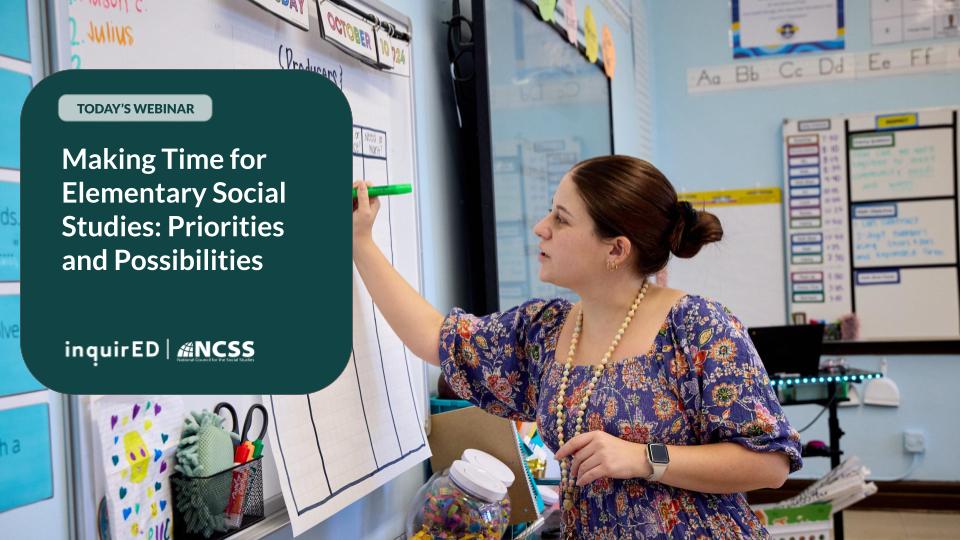
What does inquiry really look like once the classroom door closes and the lesson begins? Through classroom footage and reflective conversation, this NCSS webinar—hosted in partnership with inquirED—centered the lived experience of teaching: the routines students rely on, the talk that fuels thinking, and the task flow that keeps learning purposeful and creates opportunities for all learners. Alongside classroom teacher Hannah Berkowitz, LaKethia White of inquirED helped surface what’s often invisible beneath the surface of inquiry-rich instruction.
Key Takeaways
- Inquiry depends on strong routines that make discourse and movement productive, not chaotic.
- Inquiry classrooms are designed with low walls and high ceilings, accessible entry points and space to stretch.
- Structured talk grows out of tasks and helps students make meaning across experiences.
- Task variety invites different kinds of thinking while keeping students cognitively engaged.
- Thoughtful grouping prevents opting out and supports deeper reasoning.
- Movement and discussion routines can be taught and practiced before academic complexity is added.
Discourse Is the Glue That Holds Inquiry Together
Inquiry classrooms are busy places—but that activity is purposeful. Early in the session, LaKethia White reframed discourse as something that doesn’t sit beside tasks, but emerges from them. Students move from thinking independently to talking with partners to wrestling with ideas in groups, all in service of building understanding.
As LaKethia explained, students need chances to "see information, hear it, speak it, move with it, sort it, question it, apply it." Discourse connects those experiences, helping students process ideas rather than rush through activities.
“The talk students do is not apart from the task, it grows out of the tasks.”
This framing helped participants see that productive classroom talk is not spontaneous—it’s carefully designed, rehearsed, and revisited.
Routines Make Complex Learning Possible
Watching Hannah Berkowitz’s classroom footage made one thing clear: inquiry flows because routines are deeply embedded. Students knew how to pause and think, how to move into partner talk, and how to transition without losing focus. Those moves didn’t happen by accident.
Hannah emphasized the importance of accountability and predictability. When students know they’ll be expected to share, think time becomes meaningful. Repeating questions, modeling expectations, and practicing discussion norms throughout the year all contribute to smoother task flow.
“They know if I'm giving them time to think through something, I'm going to have them share with someone. They are accountable."
These routines create safety, especially for multilingual learners, and ensure that every student has a way into the conversation.
Grouping Choices Shape Participation
Another recurring theme was grouping. Hannah described grouping as both a practical and philosophical decision: how many students, which students, and what message those choices send. In many cases, she favors groups of three to encourage discussion without allowing anyone to disappear.
Randomized grouping tools, like popsicle sticks, signal trust and shared responsibility, even as teachers quietly make adjustments when needed. The goal is to prevent opting out while supporting meaningful debate.
“Grouping, isn’t about perfection—it’s about flexibility and responsiveness to students and tasks."
Thoughtful grouping decisions make participation visible and shared, ensuring that every student has both a voice and a responsibility in the learning.
Task Variety Supports Deeper Thinking
Across two days of instruction, students engaged in read-alouds, videos, card sorts, mingle–pair–shares, and movement-based routines like a three-corner sort. While that variety can feel overwhelming to teachers, Hannah shared that it often makes management easier, not harder.
Task shifts kept students engaged and allowed different strengths to surface. Visuals, movement, discussion, and writing worked together to ensure knowledge wasn’t a barrier when students were asked to reflect independently. As students encountered ideas in multiple ways, they had more than one entry point into the learning—and more opportunities to contribute meaningfully.
“Having a variety of tasks is actually easier in a lot of ways to manage because the students don’t have time to get bored.”
The conversation reinforced that pacing improves over time as teachers get to know their students and internalize the purpose of each lesson segment, making it easier to design experiences that support access while still leaving room for deeper reasoning and growth.
Together, these task choices illustrate how inquiry lessons are intentionally designed with low walls and high ceilings, offering accessible entry points for all learners while creating space for deeper thinking and differentiation.
Low Walls, High Ceilings by Design
LaKethia returned repeatedly to the idea that inquiry classrooms are intentionally designed for access and growth. Routines, visuals, sentence stems, and partner talk lower barriers to participation, while open-ended tasks invite deeper reasoning.
In Hannah’s classroom, every student—regardless of language background or learning needs—was positioned as a contributor. Social studies became a space where lived experience and curiosity mattered.
“Students don’t have to know everything to get started; they just need a way in.”
This design allows learners to move as far as they’re ready, without capping expectations.
What This Means for Practice
For teachers, this webinar offered reassurance that inquiry is not about relinquishing control. In fact, it requires even stronger routines so that cognitive work, not behavior management, takes center stage.
For instructional leaders, the session underscored the importance of supporting teachers as they build discourse norms and pacing over time. Inquiry flourishes when educators are given space to practice, reflect, and iterate.
For systems and curriculum leaders, the classroom footage highlighted how high-quality instructional materials, paired with professional judgment, create coherence across lessons while still allowing flexibility in the moment.
An Inquiry to Carry Forward
What routines, talk structures, and tasks in your classroom shape who participates and how students build understanding together?
As this webinar made clear, inquiry does not live in isolated strategies. It lives in the daily rhythms of classrooms. When routines, discourse, and task design work together, students do more than stay busy. They build understanding in ways that allow different learners to enter, contribute, and grow. The invitation moving forward is simple but powerful: look beneath the surface of inquiry and consider what structures support meaningful talk, purposeful learning, and thoughtful differentiation in your own classroom.
Resources
Keep reading
Start your journey
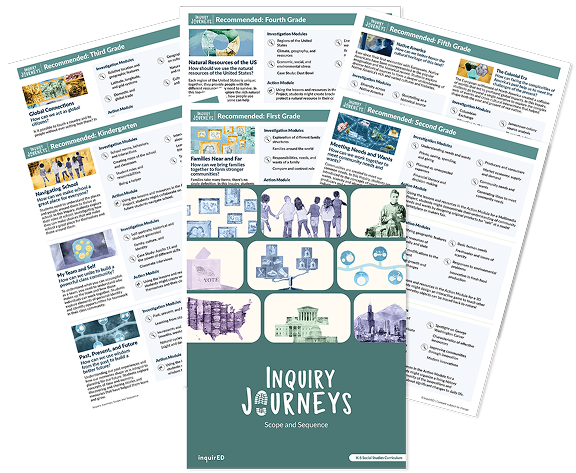
Inquiry Journeys, inquirED's K-5 social studies curriculum, engages students in inquiry-based learning, strengthens literacy skills, and supports teachers every step of the way.

inquirED supports teachers with high-quality instructional materials that make joyful, rigorous, and transferable learning possible for every student. Inkwell, our integrated core ELA and social studies elementary curriculum, brings ELA and social studies together into one coherent instructional block that builds deeper knowledge, comprehension, and literacy skills. Inquiry Journeys, our K–5 social studies curriculum, is used across the country to help students develop the deep content knowledge and inquiry skills essential for a thriving democracy,

.jpg)