From State Adoption to Classroom Instruction: Making Social Studies Materials Matter

Amit Kobrowski

Marleen Carroll

Jenny Larson

NOTE: There is no recording for this webinar.
From State Adoption to Classroom Instruction: Making Social Studies Materials Matter

inquirED


How do social studies standards move from state adoption to instructional materials to real classroom practice without losing their core purpose along the way? That question anchored the first session of the NCSS and inquirED Spring Webinar Series. Bringing together state leaders, district administrators, and instructional practitioners, the conversation surfaced what it actually takes to protect inquiry as ideas travel through complex systems.
Key Takeaways
- States operate on very different timelines and expectations for standards, materials, and implementation.
- Inquiry practices are often diluted as standards move into materials and classrooms, unless they are intentionally protected.
- Distinguishing between content standards and inquiry practices is essential for meaningful instruction.
- High-quality instructional materials are most effective when paired with curriculum-based professional learning.
- Districts that invest time,build shared understanding, and incorporate teacher voice see stronger implementation and engagement.
Understanding the Landscape from Standards to Classrooms
Across the country, states approach social studies standards and instructional materials in dramatically different ways. Some review and recommend materials. Others require them. Many leave districts largely on their own. This variation explains why implementation can feel uneven, or even confusing.
An Oregon case study illustrated how intentional timelines and clear review criteria can help preserve instructional integrity. Oregon adopted new standards in 2024, completed its materials review in 2025, and set 2026 as the required implementation year, creating space for districts to learn, plan, and pilot.
Protecting Inquiry from the ‘Game of Telephone’
One persistent challenge in social studies reform is how inquiry expectations erode as they move from standards to materials to classrooms. It can feel like a game of telephone: rich disciplinary practices get translated into surface-level questions or disconnected activities, and the original intent of the standards is weakened.
In Oregon, that risk shaped how instructional materials were reviewed. Amit Kobrowski described how the state intentionally centered Essential Disciplinary Practices as guardrails for instruction. Rather than treating inquiry and content as separate or competing priorities, these practices guide how content is taught across grade levels, shaping how questions are designed, how sources are used, and how students make meaning. The goal was to preserve the depth of the standards in daily classroom practice, not let them flatten into compliance tasks.
“Our essential disciplinary practices are like pedagogical approaches to social science: they’re about how you teach, not just what you teach.” --Amit Kobrowski
District Implementation: What It Looks Like in Practice
Hearing from Sherwood School District grounded the conversation in day-to-day reality. District leaders Marleen Carroll and Jennifer Larson shared how adopting inquiry-aligned materials required both mindset shifts and structural support, from master scheduling to professional learning.
{{testimonial-1}}
Challenges included time, pacing, and teacher comfort with inquiry. Successes showed up in student engagement, informed action projects, and teachers learning alongside their students.
“f you go into your launch year with, ‘We’re all learning this,’ it feels manageable and it feels right. --Marleen Carroll
What This Means for Practice
For teachers, the conversation reinforced that inquiry does not require having all the answers. Curiosity, questioning, and learning alongside students are part of the work. For instructional leaders, the webinar highlighted the importance of protecting time: for social studies, for professional learning, and for collaboration. Materials alone are not enough; systems matter.
At the district and state level, the session underscored how clarity, communication, and aligned supports can help inquiry survive the journey from policy to practice.
Resources from the Webinar
- Oregon Social Science Framework
- Oregon Materials Review Rubric
- Intro to Inquiry: Inquiry in Social Studies Guide (inquirED)
- PD: How Social Studies Boosts Literacy Outcomes (inquirED)
Closing Reflection
No matter where educators sit in the system, they are shaped by decisions made upstream. This webinar reminded participants that while the path from standards to classrooms is complex, it is also full of possibility, especially when inquiry is treated not as an add-on, but as the engine of social studies learning.
Resources
Keep reading
Start your journey
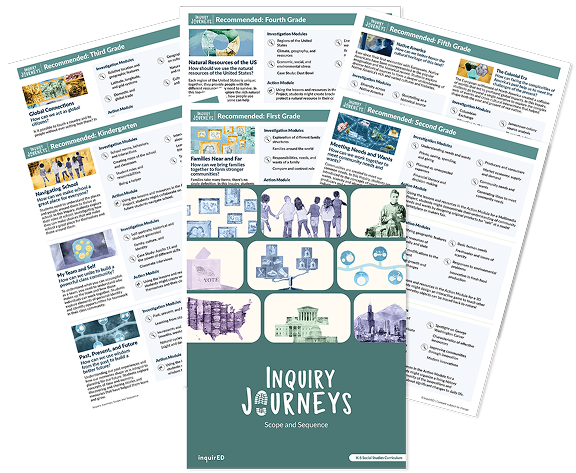
Inquiry Journeys, inquirED's K-5 social studies curriculum, engages students in inquiry-based learning, strengthens literacy skills, and supports teachers every step of the way.

Marleen Carroll
Assistant Superintendent | Sherwood School District
Marleen Carroll
Assistant Superintendent | Sherwood School District
inquirED supports teachers with high-quality instructional materials that make joyful, rigorous, and transferable learning possible for every student. Inkwell, our integrated core ELA and social studies elementary curriculum, brings ELA and social studies together into one coherent instructional block that builds deeper knowledge, comprehension, and literacy skills. Inquiry Journeys, our K–5 social studies curriculum, is used across the country to help students develop the deep content knowledge and inquiry skills essential for a thriving democracy,
.jpg)