Beyond Silos: Aligning Inclusive Instruction and Inquiry in Social Studies

Dorlande Charles

Marci Glick
.jpg)
NOTE: There is no recording for this webinar.
Beyond Silos: Aligning Inclusive Instruction and Inquiry in Social Studies

inquirED


Across the country, states are introducing inclusive history mandates designed to expand the stories students encounter in social studies classrooms. Using Illinois as a case study, Dorlande Charles and Marci Glick explore how inclusive mandates can be integrated into inquiry-based social studies instruction.
Key Takeaways
- Inclusive history mandates are intended to deepen historical accuracy, not simply add new content.
- Inquiry-based learning provides a natural structure for exploring diverse perspectives through questions, sources, and tasks.
- Strong inquiry questions invite multiple lived experiences and avoid assuming a single dominant narrative.
- Students develop deeper understanding when they grapple with perspectives rather than simply encountering them.
- Alignment between questions, sources, and tasks prevents inclusive instruction from becoming siloed.
Why Inclusive History Mandates Matter
Across Illinois, inclusive history mandates have developed gradually through legislative action, expanding the range of perspectives represented in social studies instruction. Rather than simply requiring additional units, these policies aim to broaden the historical narratives students encounter and connect those stories to civic life.
“Inclusive history is not simply about adding new topics into an already crowded curriculum. It’s about deepening students’ understanding of history and civic life.”
– Dorlande Charles
The goal is twofold. First, expanding representation strengthens historical accuracy by helping students see the past through multiple perspectives. Second, it helps students better understand how individuals and communities have shaped democratic institutions over time.
When implemented well, these mandates encourage students to investigate how movements for civil rights, disability rights, and other struggles have expanded participation in democratic life. That connection between history and civic participation is central to social studies education.
From Policy to Practice: Where Silos Appear
While the intent behind inclusive mandates is clear, implementation can sometimes produce unintended silos.
In many classrooms, inclusive instruction appears as:
- A single heritage celebration
- A standalone lesson added to an existing unit
- A new resource introduced without changing the core inquiry
These approaches often emerge from genuine efforts by teachers to incorporate additional perspectives. However, when inclusion lives outside the central investigation of a unit, it can unintentionally send the message that some stories are supplemental rather than essential.
“When inclusion lives outside the core inquiry, it can unintentionally signal that some stories are extra.” – Marci GLick
This insight reframes inclusive instruction not as a content problem, but as a design challenge. The question becomes: how can educators design inquiries where diverse perspectives are necessary to the learning itself?
Designing Inquiry That Prevents Silos
One powerful way to integrate inclusive instruction is through intentional alignment between three elements of inquiry design:
- Questions
- Sources
- Tasks
When these elements work together, inclusion becomes embedded within the intellectual work students are doing.
Questions
Inquiry begins with a compelling question. Strong questions invite multiple lived experiences and avoid assuming a single dominant narrative.
For example, consider two possible questions in a unit on the American Revolution:
- How did the Founding Fathers create a new nation?
- What makes someone a revolutionary?
The second question opens the investigation to a much broader set of historical actors. Students can explore contributions from soldiers, writers, political leaders, and everyday participants across diverse communities.
“Before choosing resources, it’s worth asking: whose experiences does this inquiry question make room for, and whose might it unintentionally push to the margins?” – Marci Glick
By starting with an expansive question, teachers create space for multiple perspectives before selecting sources or designing tasks.
Sources
Once the question is established, sources should drive the investigation rather than simply decorate the lesson.
In strong inquiries, students encounter sources that:
- Offer competing perspectives
- Reflect different lived experiences
- Reveal both what is present and what may be missing from the historical record
Students might compare accounts of the same event from different authors or examine how historical narratives change depending on who tells the story. Multiple sources create the tension and complexity necessary for historical reasoning.
Tasks
Finally, tasks determine what students actually do with the evidence they encounter.
In many classrooms, tasks stop at comprehension: answering questions or extracting facts from a text. Inquiry-based tasks go further by asking students to interpret, compare, and evaluate perspectives.
Students might:
- Compare how different individuals experienced the same event
- Debate competing interpretations of a historical moment
- Propose new representations of historical contributions
These tasks require students to grapple with historical evidence and justify their conclusions. When questions, sources, and tasks are aligned, inclusive instruction becomes inseparable from the inquiry itself.
What This Means for Practice
For educators and instructional leaders, the key insight from the webinar is that inclusive mandates are not primarily about adding new content. Instead, they invite a shift in instructional design.
When inquiry questions invite multiple perspectives, when sources reflect a range of experiences, and when tasks require students to reason across those perspectives, inclusive instruction becomes part of the intellectual core of social studies.
For teachers, this means examining unit design through a new lens: Who becomes visible in the question? What perspectives do the sources introduce? What thinking are students asked to do?
For instructional leaders and districts, the work often begins with supporting teachers in designing inquiries that integrate representation from the start rather than layering it on afterward.
Resources from the Webinar
Illinois State Board of Education Social Science Resources
Closing Reflection
Inclusive history mandates are appearing in states across the country. But policy alone does not transform classroom learning.
That transformation happens when educators design inquiries that invite students to wrestle with multiple perspectives, evaluate evidence, and construct conclusions based on evidence from primary and secondary sources.
Resources
Keep reading
Start your journey
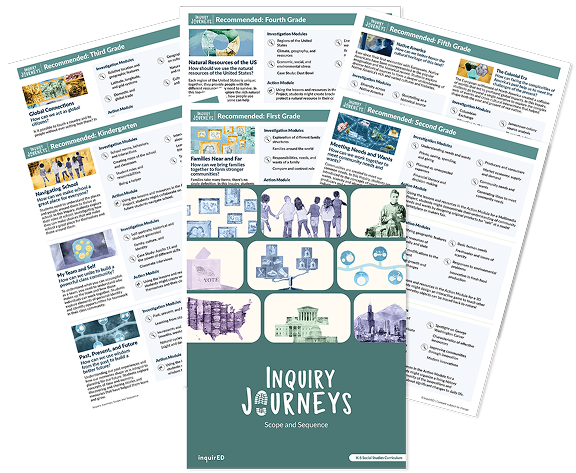
Inquiry Journeys, inquirED's K-5 social studies curriculum, engages students in inquiry-based learning, strengthens literacy skills, and supports teachers every step of the way.

inquirED supports teachers with high-quality instructional materials that make joyful, rigorous, and transferable learning possible for every student. Inkwell, our integrated core ELA and social studies elementary curriculum, brings ELA and social studies together into one coherent instructional block that builds deeper knowledge, comprehension, and literacy skills. Inquiry Journeys, our K–5 social studies curriculum, is used across the country to help students develop the deep content knowledge and inquiry skills essential for a thriving democracy,
.jpg)