How Waukee Built Equitable Access to Knowledge Through Complex Texts

NOTE: There is no recording for this webinar.
How Waukee Built Equitable Access to Knowledge Through Complex Texts

inquirED


When teachers in Waukee Community School District first started using Inquiry Journeys (K-5 social studies curriculum), they quickly noticed how rigorous it was. The texts were layered and dense, and the lessons invited students to read, discuss, and think deeply about big ideas. Teachers wondered whether students would be able to engage meaningfully with texts that demanded more than surface-level reading. The question mirrored what many districts are asking: How do we ensure every student has access to the knowledge-building power of complex, grade-level texts? Through coaching, collaboration, and the adoption of high-quality instructional materials in social studies, Waukee set out to build a culture of inquiry that expanded access to knowledge for every learner.
Key Takeaways
- Equitable access to knowledge grows when complex texts are built directly into the social studies curriculum.
- Reading, writing, and discussion serve as tools for building disciplinary understanding.
- Productive discomfort leads to lasting professional growth through collaboration and coaching.
- An elementary social studies curriculum can meaningfully reinforce literacy outcomes.
- Sustained professional learning supports consistency and depth across classrooms.
When Complex Texts Feel Out of Reach
Before adopting Inquiry Journeys, Waukee teachers were already committed to inquiry-based learning. District leaders, however, saw an opportunity to ensure that every student could access grade-level texts and ideas. When they explored Inquiry Journeys, they found a curriculum that supported rigor. The real work would be preparing teachers to facilitate that level of rigor consistently across classrooms.
Ali Locker, Director of Elementary Teaching and Learning at Waukee Community School District in Iowa, recalled her first impression of the materials. “Immediately I could see within the program, within the curriculum materials, that inquiry was the foundation, and cross-content integration with literacy was also a primary focus,” she said. “The fact that those two things existed within these instructional materials, I was interested from the get-go.”
That combination of inquiry and literacy became the foundation for implementation. Teachers began to see that complexity did not have to be a barrier. Structured discussion, purposeful reading, and writing tasks helped students build knowledge actively and connect ideas across content areas.
“Immediately I could see within the program, within the curriculum materials, that inquiry was the foundation, and cross content integration with literacy was also a primary focus.”
The Texts That Made the Difference: Primary Sources, Perspective, and Purpose
The turning point was when teachers realized that students could engage with complex ideas because the sources were intentionally selected, sequenced, and developmentally appropriate. The curriculum did not ask teachers to search for materials or guess at alignment. The texts were already there, carefully chosen to support grade-level thinking. Each unit deliberately pairs primary and secondary sources so students analyze perspectives, weigh evidence, and construct historical understanding instead of passively receiving information.
“It was really nice to have the articles and have the text that we wanted kids to engage with right there. It wasn't us having to search and hoping that it was appropriate developmentally,” said Laura Olson, TK-5 Science and Social Studies Instructional Coach.
The strength of the materials extended beyond accessibility. Teachers saw students encountering multiple perspectives across units and modules, deepening both understanding and engagement. “To see the different perspectives that were represented throughout the modules, throughout the units was amazing,” Olson shared.
That combination of rigor, developmental appropriateness, and diverse viewpoints changed classroom dynamics. Students were not shielded from complexity; they were guided into it. With strong primary and secondary sources at the center of the elementary social studies curriculum, teachers could focus on instruction instead of resource gathering, and students could focus on building knowledge through evidence and discussion.
Building Teacher Confidence Through Inquiry
As teachers gained confidence, they began to trust the program’s design. Olson encouraged her colleagues to lean into the inquiry process. “Trust the process and the sequence of how the lessons and the units are designed,” she said. “It really does flow and it does answer those guiding questions that show up at the beginning of every unit and every module.”
This trust allowed teachers to focus on facilitation and reflection. Instead of questioning whether texts were too difficult, teachers began asking how to scaffold discussion, prompt stronger evidence-based responses, and push thinking further. Over time, students demonstrated greater stamina with complex texts, stronger evidence-based responses, and more substantive classroom discussions.
For Waukee classrooms, inquiry-based social studies went from being just an instructional mode to a mindset that shaped how teachers approached literacy, social studies, and learning itself.
{{download}}
Partnership, Professional Learning, and Long-Term Growth
Waukee’s success was strengthened by an ongoing partnership with inquirED. “If Inquiry Journeys is something that a district takes on, you will have top-notch support from the inquirED team. I've never actually seen anything quite like it,” Locker shared. “To have that level of support from an organization, what it told me is that you all care about the work that's gone into this product and into these materials.”
{{testimonial-1}}
This partnership between Waukee leaders and teachers with the inquirED team ensured professional learning remained consistent and responsive. With inquirED’s support, teachers strengthened their ability to scaffold reading, promote discussion, and connect literacy across disciplines. Professional learning sessions created space for teachers to examine student work, refine questioning strategies, and align expectations around what grade-level rigor looks like in practice. What began as concern about text difficulty evolved into a districtwide commitment to rigorous, knowledge-rich instruction for every learner.
Summary
- Waukee Community School District in Iowa began with a challenge: how to make complex texts accessible without reducing rigor.
- Inquiry Journeys offered a solution rooted in inquiry, literacy, and collaboration.
- Teachers built trust in the design, leading to stronger instruction and student engagement.
- Students demonstrated real-world learning through informed action.
- A lasting partnership with inquirED sustained growth and deepened professional learning.
Resources
Keep reading
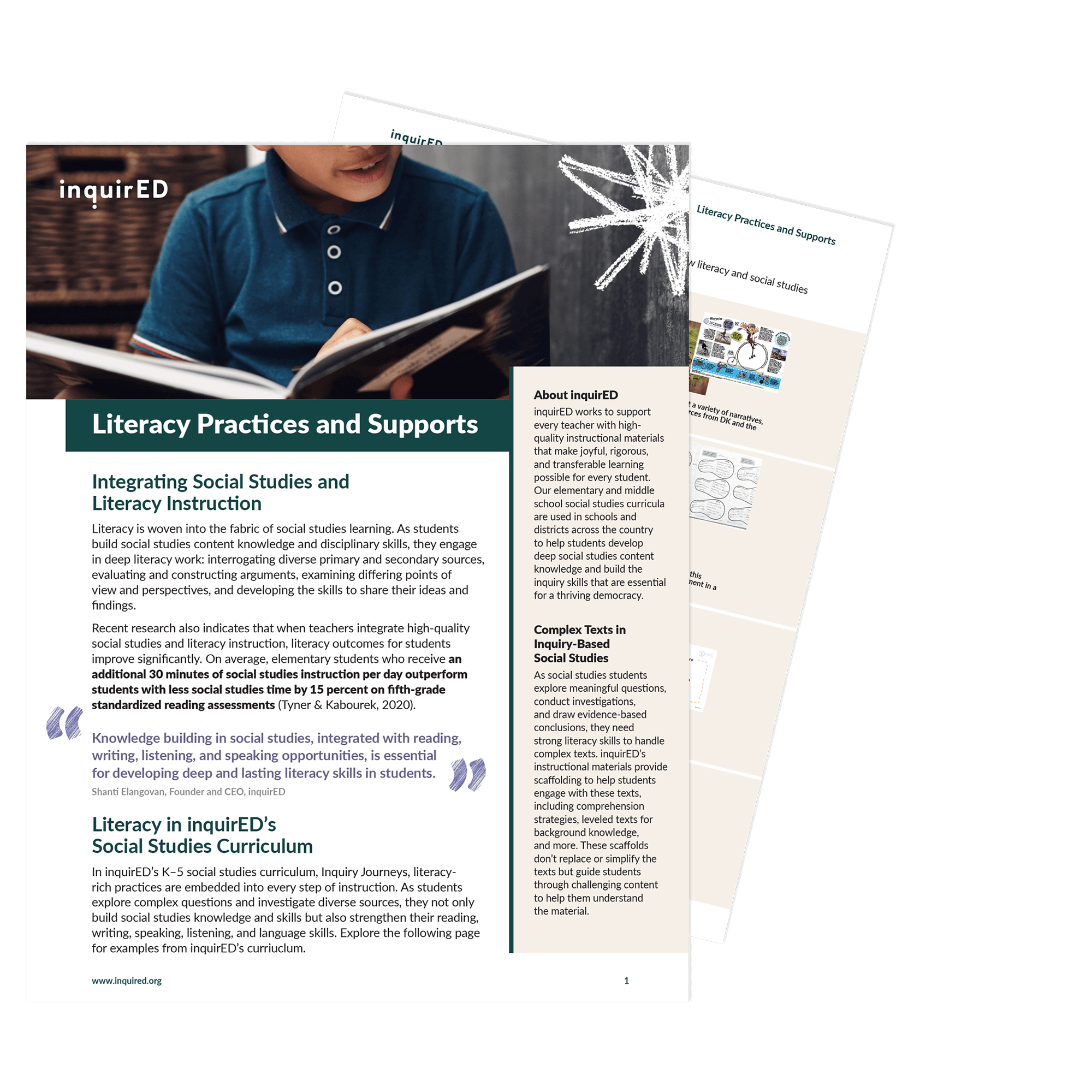
Use Primary and Secondary Sources to Strengthen Literacy
Discover how to make complex, grade-level texts accessible to every learner.
Start your journey
Inquiry Journeys, inquirED's K-5 social studies curriculum, engages students in inquiry-based learning, strengthens literacy skills, and supports teachers every step of the way.

Ali Locker
Director of Elementary Teaching and Learning, Waukee CSD
Ali Locker
Director of Elementary Teaching and Learning, Waukee CSD
inquirED supports teachers with high-quality instructional materials that make joyful, rigorous, and transferable learning possible for every student. Inkwell, our integrated core ELA and social studies elementary curriculum, brings ELA and social studies together into one coherent instructional block that builds deeper knowledge, comprehension, and literacy skills. Inquiry Journeys, our K–5 social studies curriculum, is used across the country to help students develop the deep content knowledge and inquiry skills essential for a thriving democracy,