Curriculum

Elementary

New

Integrated ELA & Social Studies

inkwell-logo-white

Social Studies

Middle School

Social Studies

Upcoming Product webinar

See Inkwell live

Inkwell is our K-2 core curriculum that teaches ELA and social studies in one block. Join a 30-minute live demo with the team behind the curriculum. We'll walk through what it looks like in practice, where it fits alongside your foundational skills program, and what year-one adoption requires.

Register
Professional Learning
Resources

Resource Collections

Downloadable guides, frameworks, and tools designed to help district leaders take action on high-quality ELA curricula and instruction. Looking for our most downloaded resources? Check the quick links below.

Making the Case for Integrated Core Curricula

The Integrated Instructional Block

Integration in Elementary Instruction

Blog

Fresh ideas, research, and reflections to help district leaders stay sharp and responsive in an evolving landscape.

Webinars

Real-time conversations and on-demand learning with experts and district leaders tackling challenges in education.

Lit Talk

Inkwell

Source Material

Inquiry Journeys

Great first eight

new webinar series

Where the Day Goes: Rethinking Instructional Time in K–5 Classrooms

Time is the resource every educator runs short on. Join Dr. Nell K. Duke and Dr. Matt Kraft for a free Lit Talk on instructional time in PK–5 classrooms.

Save your spot
Log inContact sales
Log in
Contact sales

Contact sales

Cookie Settings

We use cookies to provide you with the best possible experience. They also allow us to analyze user behavior in order to constantly improve the website for you. See our Privacy Policy

Thank you! Your submission has been received!
Oops! Something went wrong while submitting the form.
Source Material
BACK TO ALL EPISODES
Season
1
Episode
1
|
Webinar recap

By Design, Not By Accident: Building a Classroom Culture for Inquiry

LaKethia White

LaKethia White

PD and Learning Lead at inquirED
Hannah Berkowitz

Hannah Berkowitz

5th-grade teacher, Jane Stenson Elementary
Cornelius Minor

Cornelius Minor

Educator and Author | The Minor Collective
Sep 25, 2026
7
MIN READ
Copied!

I am the text that will be copied.

NOTE: There is no recording for this webinar.

Webinars
BACK TO BLOG

By Design, Not By Accident: Building a Classroom Culture for Inquiry

inquirED

Sep 25, 2026
7
MIN READ
Copied!

I am the text that will be copied.

Table of Contents
H1 Heading
H2 Heading
H3 Heading
in this recap
H2 Heading
H3 Heading
H4 Heading

K-5 Social Studies

illustration of kid holding question mark

K–2 integrated ELA and social studies

Next Source Material

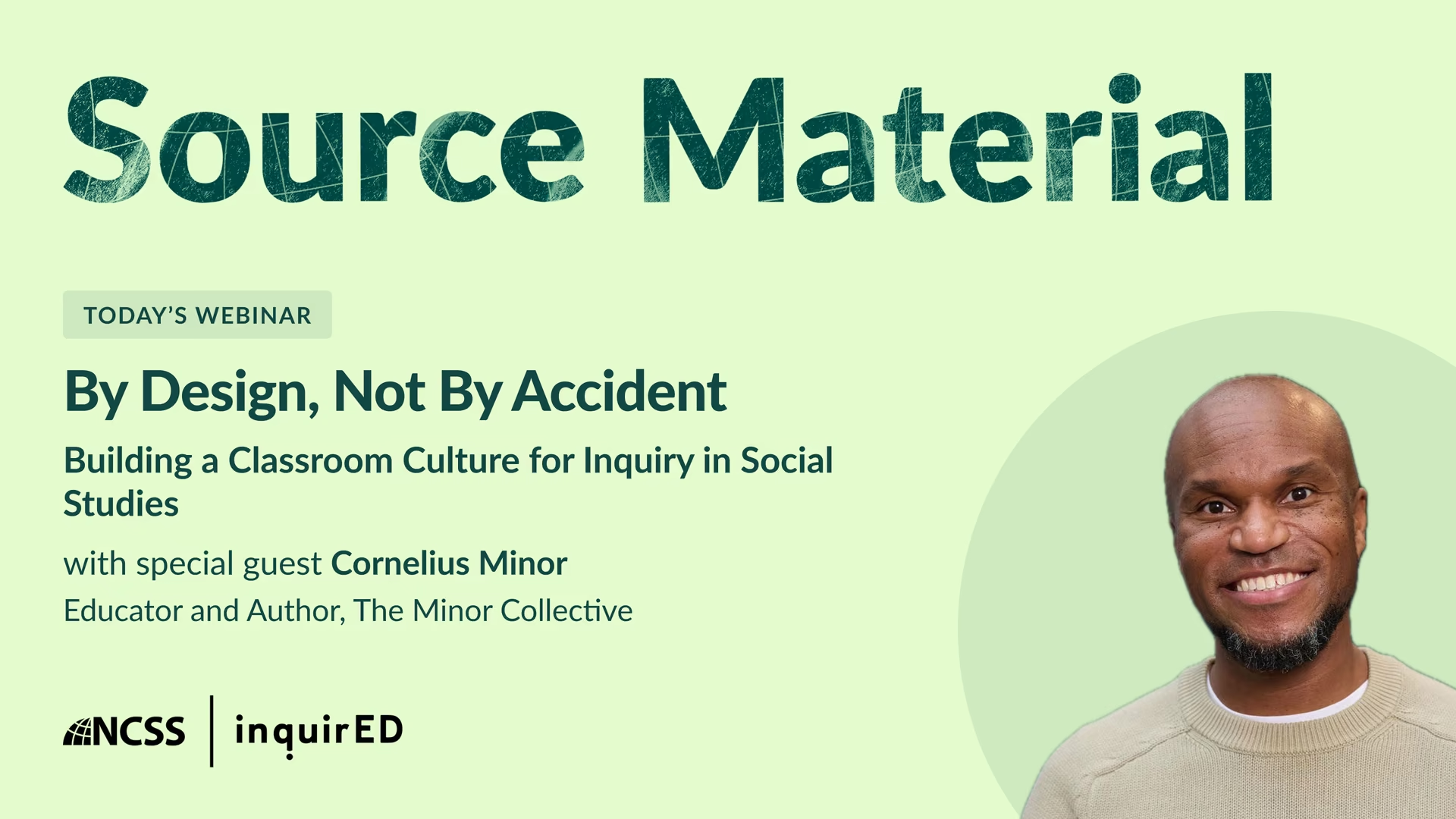
By Design, Not By Accident: Building a Classroom Culture for Inquiry in Social Studies

Reserve a seat →
September 17, 2026
Next Source Material

Three Moves That Change the Room: Inquiry-Based Social Studies for Multilingual Learners

Reserve a seat →
November 12, 2026
Next Source Material

A Different Kind of Invitation: Inquiry and the Reluctant Learner

Reserve a seat →
February 4, 2027
Next Source Material

Reading the Room: What Student Work Tells Us That Nothing Else Can

Reserve a seat →
March 4, 2027

Strong inquiry classrooms get built on purpose, starting on the first day of school. In the premiere episode of Source Material from NCSS and inquirED, hosts LaKethia White and Hannah Berkowitz looked at how teachers set up collaboration, name the culture they want, and rebuild it when it slips. Guest Cornelius Minor then widened the lens to the principals and district leaders who help that culture take hold across a system.

Key Takeaways

  • Collaboration is a skill students learn through practice, and low-stakes group tasks early in the year give them a feel for teamwork before the content gets hard.
  • Students need to know how working together should look on a specific task, along with what they're supposed to do.
  • Every classroom has a culture made of beliefs, language, and practices, and it forms whether or not a teacher plans for it.
  • When culture slips, teachers can reteach it the way they reteach academic content: pick one routine, name what success looks and sounds like, and practice it.
  • Cornelius Minor designs inquiry classrooms around three pillars: curiosity, conflict, and change.
  • Leaders help inquiry spread by modeling it, from principals who admit what they don't know to teachers who use action research to make the case for change.

Collaboration is a skill students practice

Hannah opened the episode's first segment, You're a Piece of Work, with two photos from her fifth grade classroom. On the left, students play a low-stakes group game in the first week of school. On the right, about a week later, the same students research a cultural area of Indigenous peoples of the Americas and prepare a presentation.

Hannah uses the gap between those two photos to make her case about inquiry-based social studies: "This is a skill. It's not innate in all children or in most kids, right? They need practice." So the early weeks are for practicing collaboration skills themselves (how to talk with a teammate, how to communicate with kindness, how to stay focused when the table next to you gets loud), with content light enough that the teamwork gets the attention. Students then carry that feeling of working as a team into harder, content-heavy work.

Early in her career, Hannah assumed that telling students to go work with a partner was enough. Walking the classroom, she'd see one student holding the text while another stared off into space. Now she spells out what collaboration looks like on each task, like taking turns reading paragraphs or making sure everybody's handwriting appears on the poster. "I really try to set up both the what and the how before they go to work as a team," she said.

“They don't just need to know what they are doing when we ask them to work together. They need to know how that's going to look.”
Hannah Berkowitz

{{download}}

Every classroom has a culture, planned or not

Since Source Material is a social studies show, LaKethia borrowed a definition from the social sciences. Anthropologists describe a culture through many elements, and she focused on three: beliefs (the values a group holds about what is good and true), language (the words and symbols it uses), and practices (the routines and rituals it repeats). Every classroom has all three, and they grow over time whether or not a teacher shapes them. "So you're either going to plan for your classroom culture or it's just going to happen," she said.

Hannah then asked about LaKethia's coaching work and a time when culture wasn't taking hold by October. LaKethia described a teacher who cared deeply about his students and wanted them to speak up and make choices. Wary of being controlling, he let disruptive behavior go unchecked until it snowballed. The realization they reached together was that "sharing power is not the same thing as letting go of your classroom completely." So they rehearsed the culture explicitly, practicing what it sounds like to enter a group conversation or repair a conflict, and trying redirections that keep the lesson moving.

When a culture feels too far gone, LaKethia's advice is to treat it like any lesson that didn't stick: "just like you reteach academic content when the kids don't get it, you can reteach culture." Start with the one routine creating the biggest barrier to inquiry, name what success looks and sounds like, practice it, and follow through consistently.

“It's not a classroom without boundaries. It's a classroom where boundaries ensure that students can have their voices heard.”
LaKethia White

Three pillars: curiosity, conflict, and change

When Cornelius Minor joined, he named what stood out in Hannah's practice: her intentionality, and her plan for when things fall apart. "Because it will fall apart," he said, so he keeps a recovery plan in his back pocket. He then described the three pillars he constructs in an inquiry-based classroom, so that when everything else falls apart, the pillars hold and the class can rebuild.

The first pillar is curiosity. "Every human on the planet is born curious, but often curiosity is socialized out of us," he said, so his early-year teaching centers on curiosity activities that remind students of something they already had.

Conflict comes second, in ideas, behaviors, identities, and actions. Cornelius compares a classroom to a skyscraper designed to flex and sway: "if I build a classroom and I don't build that classroom to be conflict proof, then I'm doing it wrong." Change is the third pillar, which means teaching students how to change their minds and that it's okay to do so, a skill he sees many adults struggling with right now.

“I am simply reminding kids that they were born curious.”
Cornelius Minor

Leaders make inquiry visible beyond one classroom

LaKethia then pushed the conversation to the building and district levels. Cornelius drew on Carter G. Woodson's idea that classrooms are permeable spaces shaped by the society around them, so a leader who wants inquiry alive in classrooms has to keep it alive in faculty meetings and professional learning too. A principal, in his words, is the lead learner: "I have to model here's what it looks like to not know in public."

For district leaders, Cornelius offered Miles Davis’s Kind of Blue as a model, and the lesson is about structure. Davis started with a clear goal, the mood he wanted the album to capture. He chose a technique, and he invited John Coltrane and Cannonball Adderley because they knew it. Cornelius sees the same three jobs for a district leader: set the specific goal, lay out how the district will get there, and bring in the teachers and coaches with the expertise to do the work. What a leader can’t do is dictate every note. “I invited you here because you have the expertise,” he said. “I invited you here because you understand the vision.” With that structure in place, he looks for signs the vision is taking hold: teachers who can talk about it, and students who ask big questions, make connections, and draw conclusions.

For teachers whose district systems reward compliance over inquiry, Cornelius recommended action research. At his middle school, he and his colleagues noticed that the students spending the most time in the hallway were often the ones who struggled most with reading, and that they were avoiding embarrassment. They redesigned the first seven minutes of class around hands-on, collaborative activities where students could succeed early, tested it for 10 days, and brought the results to their principal. "We're not approaching the principal with complaints. Actually, we're approaching the principal with data," he said.

“Nothing on the album was planned, but everything on the album was intentional.”
Cornelius Minor

What This Means for Practice

For teachers, the first weeks of school are the time to teach routines on purpose. Pick the routines you'll return to all year, like Hannah's Stand Up, Hand Up, Pair Up, and practice them with low-stakes questions first, so students already know the moves when the content gets harder. When a routine slips, reteach it the way you'd reteach a math concept.

For coaches, the work starts with listening. When a teacher pushes back on something new, Cornelius asks what that person needs, whether that's time, a practice partner, or flexibility. He described rehearsing hard lessons with a colleague in the hallway before students arrived, so neither of them tried something for the first time in front of a class.

For school and district leaders, the message is to model inquiry in how the adults learn: name what you don't know, and treat evidence from classrooms, like the results of a teacher's action research, as the way decisions get made.

Closing Reflection

Near the end of the conversation, Cornelius said that what exists in a classroom today becomes our society tomorrow. Hannah's first-week routines and a principal willing to not know in public point in the same direction. A culture for inquiry takes intention at every level, and each of those levels has a next step it can take this week.

Collaboration is a skill students practice

Hannah opened the episode's first segment, You're a Piece of Work, with two photos from her fifth grade classroom. On the left, students play a low-stakes group game in the first week of school. On the right, about a week later, the same students research a cultural area of Indigenous peoples of the Americas and prepare a presentation.

Hannah uses the gap between those two photos to make her case about inquiry-based social studies: "This is a skill. It's not innate in all children or in most kids, right? They need practice." So the early weeks are for practicing collaboration skills themselves (how to talk with a teammate, how to communicate with kindness, how to stay focused when the table next to you gets loud), with content light enough that the teamwork gets the attention. Students then carry that feeling of working as a team into harder, content-heavy work.

Early in her career, Hannah assumed that telling students to go work with a partner was enough. Walking the classroom, she'd see one student holding the text while another stared off into space. Now she spells out what collaboration looks like on each task, like taking turns reading paragraphs or making sure everybody's handwriting appears on the poster. "I really try to set up both the what and the how before they go to work as a team," she said.

“They don't just need to know what they are doing when we ask them to work together. They need to know how that's going to look.”
Hannah Berkowitz

{{download}}

Every classroom has a culture, planned or not

Since Source Material is a social studies show, LaKethia borrowed a definition from the social sciences. Anthropologists describe a culture through many elements, and she focused on three: beliefs (the values a group holds about what is good and true), language (the words and symbols it uses), and practices (the routines and rituals it repeats). Every classroom has all three, and they grow over time whether or not a teacher shapes them. "So you're either going to plan for your classroom culture or it's just going to happen," she said.

Hannah then asked about LaKethia's coaching work and a time when culture wasn't taking hold by October. LaKethia described a teacher who cared deeply about his students and wanted them to speak up and make choices. Wary of being controlling, he let disruptive behavior go unchecked until it snowballed. The realization they reached together was that "sharing power is not the same thing as letting go of your classroom completely." So they rehearsed the culture explicitly, practicing what it sounds like to enter a group conversation or repair a conflict, and trying redirections that keep the lesson moving.

When a culture feels too far gone, LaKethia's advice is to treat it like any lesson that didn't stick: "just like you reteach academic content when the kids don't get it, you can reteach culture." Start with the one routine creating the biggest barrier to inquiry, name what success looks and sounds like, practice it, and follow through consistently.

“It's not a classroom without boundaries. It's a classroom where boundaries ensure that students can have their voices heard.”
LaKethia White

Three pillars: curiosity, conflict, and change

When Cornelius Minor joined, he named what stood out in Hannah's practice: her intentionality, and her plan for when things fall apart. "Because it will fall apart," he said, so he keeps a recovery plan in his back pocket. He then described the three pillars he constructs in an inquiry-based classroom, so that when everything else falls apart, the pillars hold and the class can rebuild.

The first pillar is curiosity. "Every human on the planet is born curious, but often curiosity is socialized out of us," he said, so his early-year teaching centers on curiosity activities that remind students of something they already had.

Conflict comes second, in ideas, behaviors, identities, and actions. Cornelius compares a classroom to a skyscraper designed to flex and sway: "if I build a classroom and I don't build that classroom to be conflict proof, then I'm doing it wrong." Change is the third pillar, which means teaching students how to change their minds and that it's okay to do so, a skill he sees many adults struggling with right now.

“I am simply reminding kids that they were born curious.”
Cornelius Minor

Leaders make inquiry visible beyond one classroom

LaKethia then pushed the conversation to the building and district levels. Cornelius drew on Carter G. Woodson's idea that classrooms are permeable spaces shaped by the society around them, so a leader who wants inquiry alive in classrooms has to keep it alive in faculty meetings and professional learning too. A principal, in his words, is the lead learner: "I have to model here's what it looks like to not know in public."

For district leaders, Cornelius offered Miles Davis’s Kind of Blue as a model, and the lesson is about structure. Davis started with a clear goal, the mood he wanted the album to capture. He chose a technique, and he invited John Coltrane and Cannonball Adderley because they knew it. Cornelius sees the same three jobs for a district leader: set the specific goal, lay out how the district will get there, and bring in the teachers and coaches with the expertise to do the work. What a leader can’t do is dictate every note. “I invited you here because you have the expertise,” he said. “I invited you here because you understand the vision.” With that structure in place, he looks for signs the vision is taking hold: teachers who can talk about it, and students who ask big questions, make connections, and draw conclusions.

For teachers whose district systems reward compliance over inquiry, Cornelius recommended action research. At his middle school, he and his colleagues noticed that the students spending the most time in the hallway were often the ones who struggled most with reading, and that they were avoiding embarrassment. They redesigned the first seven minutes of class around hands-on, collaborative activities where students could succeed early, tested it for 10 days, and brought the results to their principal. "We're not approaching the principal with complaints. Actually, we're approaching the principal with data," he said.

“Nothing on the album was planned, but everything on the album was intentional.”
Cornelius Minor

What This Means for Practice

For teachers, the first weeks of school are the time to teach routines on purpose. Pick the routines you'll return to all year, like Hannah's Stand Up, Hand Up, Pair Up, and practice them with low-stakes questions first, so students already know the moves when the content gets harder. When a routine slips, reteach it the way you'd reteach a math concept.

For coaches, the work starts with listening. When a teacher pushes back on something new, Cornelius asks what that person needs, whether that's time, a practice partner, or flexibility. He described rehearsing hard lessons with a colleague in the hallway before students arrived, so neither of them tried something for the first time in front of a class.

For school and district leaders, the message is to model inquiry in how the adults learn: name what you don't know, and treat evidence from classrooms, like the results of a teacher's action research, as the way decisions get made.

Closing Reflection

Near the end of the conversation, Cornelius said that what exists in a classroom today becomes our society tomorrow. Hannah's first-week routines and a principal willing to not know in public point in the same direction. A culture for inquiry takes intention at every level, and each of those levels has a next step it can take this week.

Watch the recording

Resources

Keep reading

Name

previous

Name

Next

By Design, Not By Accident: Building a Classroom Culture for Inquiry

Making Time for Elementary Social Studies: Priorities and Possibilities

“The People Doing the Talking Are Doing the Thinking”: Inquiry in Eastern Carver County Schools

How Waukee Built Equitable Access to Knowledge Through Complex Texts

Beyond Silos: Aligning Inclusive Instruction and Inquiry in Social Studies

Designing for Depth: Giving Writing Its Due in Early Literacy

Low Floors, High Ceilings: What’s Happening in Skokie Classrooms

From State Adoption to Classroom Instruction: Making Social Studies Materials Matter

How East Haven school district puts their vision of a graduate to practice

Writing for Meaning and Understanding: The Power of Integrated ELA and Social Studies

Deeper Knowledge and Comprehension Through ELA and Social Studies Integration

The Cognitive Load Problem: Why Too Many Programs Undermine Learning

The Elementary Time Problem: Too Much to Teach, Too Little Time

Canby Brings Oregon’s Vision for Social Science Education to Life

How Standards-Based Inquiry Sparked Innovation in Iowa City Community School District

How West Aurora Turned Social Science into Literacy Gains

Discourse and Differentiation: A Day in the Life of Inquiry in a 5th-Grade Classroom

Implementing Elementary Social Studies Across a District

The Missing Piece in Reading Comprehension: Social Studies

How SFUSD Brought Inquiry-Based Social Studies to Life

Culturally Responsive Education in Social Studies

How to Choose a High-Quality Elementary Social Studies Curriculum

Exploring the Inquiry Journeys Logic Model

How Oconomowoc made standards stick

Creative ways districts are making time for K-5 social studies

Your Guide to Meaningful Inquiry Walls in the Classroom

Using Inquiry in Elementary Social Studies

Think-Pair-Share | Inquiry Lesson Plan Strategy

Social Studies Projects: Give Students the Keys to Success

Can Curriculum-Based Professional Learning Transform Teaching?

Predict Learn Conclude | Inquiry Lesson Plan Strategy

Literacy in Social Studies: Layered Learning with Primary and Secondary Sources

Inquiry Journeys: Literacy Practices and Supports

Inquiry in Action: Classroom Spotlights

Creating a Roadmap for Social Studies Curriculum Review and Adoption

Wisconsin Makes The Case For Elementary Social Studies

"Yes, And..." | Inquiry Lesson Plan Strategy

Why Inquiry-Based Social Studies Matters in K–5 Classrooms

Elementary Social Studies | What is Informed Action?

What is Inquiry-Based Social Studies?

Inquiry in Social Studies Classrooms

What is the best inquiry process for elementary social studies curriculum?

Using Content-Area Literacy Strategies in Social Studies Instruction

Supporting the Shift to Inquiry

Keeping Curiosity Alive

Up to the Task: How to Support Student-Led Learning in Elementary Social Studies

Integrating SEL and Social Studies

Teaching in an Election Season: Rights and Responsibilities

Tell Me More: Using Diverse Books and Inquiry to Teach History

Voice and Choice in Inquiry-Based Learning

Using Primary Sources from the Library of Congress through Distance Learning

Un-level That Text! Integrating Literacy and Elementary Social Studies

Tools for Identifying High-Quality Social Studies Instruction

Time to Design: inquirED's Elementary Social Studies Curriculum Supports Teachers

The State of K-8 Social Studies

Bringing Learning to Life: The Power of Informed Action in Social Studies

The Social Studies ELA Connection: Making the Case For Elementary Social Studies

Theory to Practice: Implementing High-Quality Instruction

The Future of Social Studies: Webinar Series Launch

The Steps Toward Inquiry in Social Studies (Series Launch)

The Power of High-Quality Instructional Materials

Media Literacy: Making The Case For Elementary Social Studies

Social Studies in the Age of Disinformation: Making the Case For Elementary Social Studies

Storytime in Social Studies: Using Picture Books Across an Inquiry

Making the Case For Elementary Social Studies: District Leaders

Building Deep Background Knowledge: Making The Case For Elementary Social Studies

High-Quality Instructional Materials in Social Studies

Socratic Seminar | Inquiry Lesson Plan Strategy

Seen, Shared, Shaped Over Time: Making Learning Visible in Social Studies

The Social Studies Curriculum Review Guide

See Think Wonder | Inquiry Lesson Plan Strategy

Searching for Social Studies: Denver Public Schools

Media Literacy: Primary and Secondary Sources in Inquiry Journeys

Social Studies Curriculum Review and Adoption

Schema Building and Knowledge Transfer

Questioning: The Key to Unlocking the Power of Inquiry in Social Studies

What are your district's priorities for curriculum review and adoption?

Picture Walks and Other Pre-Reading Strategies for Early Literacy Development

Multimodal Learning in Inquiry Journeys

New Standards, New Directions: When Your State Goes All-In for Inquiry

Note Card Reflection | Inquiry Lesson Plan Strategy

Making Time for Elementary Social Studies

Layers of Meaning: Knowledge Building and Complex Texts

Sources as Mirrors and Windows: Making the Case for Elementary Social Studies

Mingle Pair Share | Inquiry Lesson Plan Strategy

Making the Case for Elementary Social Studies

Civic Life in the Era of Truth Decay: Making the Case for Elementary Social Studies

Inquiry Unit Design

Why Inquiry Skills Matter in K–5 Social Studies Classrooms

Inquiry Journeys: Elementary Social Studies Curriculum Resources

Inquiry vs. Knowledge Building: Dismantling the False Dichotomy

Inquiry-Based Elementary Social Studies and the C3 Framework

Inquiry Advocates: Partners with inquirED

Inquiry-Based Elementary Social Studies and the Common Core

Informed Action in Inquiry Journeys: A Garden Grows in Ohio

Inquiry-Based Learning: Research

inquirED's 21st Century Skills

Inquiry-Based Elementary Social Studies and the CASEL Competencies

Implementing Elementary Social Studies: Best Practices from District Leaders

Idea Clustering | Inquiry Lesson Plan Strategy

Bring Inquiry Into Your Classroom Culture

Our free guide walks through what inquiry looks like in elementary social studies, with practical ways to start building it with your students.

Download now

Start your journey

Inquiry Journeys, inquirED's K-5 social studies curriculum, engages students in inquiry-based learning, strengthens literacy skills, and supports teachers every step of the way.

Get in touch
illustration of kid holding question mark

No items found.

inquirED supports teachers with high-quality instructional materials that make joyful, rigorous, and transferable learning possible for every student. Inkwell, our integrated core ELA and social studies elementary curriculum, brings ELA and social studies together into one coherent instructional block that builds deeper knowledge, comprehension, and literacy skills. Inquiry Journeys, our K–5 social studies curriculum, is used across the country to help students develop the deep content knowledge and inquiry skills essential for a thriving democracy,
Copied!

I am the text that will be copied.

Webinars

Subscribe to receive email updates from inquirED

Related posts

See all resources

Webinars

Making Time for Elementary Social Studies: Priorities and Possibilities

May 7, 2026
9
MIN READ

Webinars

Beyond Silos: Aligning Inclusive Instruction and Inquiry in Social Studies

Mar 5, 2026
5
MIN READ

Webinars

Designing for Depth: Giving Writing Its Due in Early Literacy

Mar 4, 2026
7
MIN READ
See all resources
Contact us

Contact sales

Ready to learn more?

Connect with someone from the inquirED team to schedule a demo or learn more about our products.

Connect with us

Want the latest webinars, resources, and tools? Sign up for inquirED’s newsletter.

About inquirED

About UsOur TeamCareers

Get in touch

General InquiriesSales

Contact sales

Social

LinkedIn
Instagram
Facebook
YouTube

© {year} inquirED Inc. All rights reserved.

Data + Security
|
Privacy Policy
|
Accessibility
|
Terms and Conditions