Curriculum

Pre-K/TK

Pre-K/TK

New

Elementary

Integrated ELA & Social Studies

inkwell-logo-white

Social Studies

Middle School

Social Studies

Upcoming Product webinar

See Inkwell live

Inkwell is our K-2 core curriculum that teaches ELA and social studies in one block. Join a 30-minute live demo with the team behind the curriculum. We'll walk through what it looks like in practice, where it fits alongside your foundational skills program, and what year-one adoption requires.

Register
Professional Learning
Resources

Resource Collections

Downloadable guides, frameworks, and tools designed to help district leaders take action on high-quality ELA curricula and instruction. Looking for our most downloaded resources? Check the quick links below.

Making the Case for Integrated Core Curricula

The Integrated Instructional Block

Integration in Elementary Instruction

Blog

Fresh ideas, research, and reflections to help district leaders stay sharp and responsive in an evolving landscape.

Webinars

Real-time conversations and on-demand learning with experts and district leaders tackling challenges in education.

Lit Talk

Inkwell

Source Material

Inquiry Journeys

Great first eight

new webinar series

Where the Day Goes: Rethinking Instructional Time in K–5 Classrooms

Time is the resource every educator runs short on. Join Dr. Nell K. Duke and Dr. Matt Kraft for a free Lit Talk on instructional time in PK–5 classrooms.

Save your spot
Log inContact sales
Log in
Contact sales

Contact sales

Cookie Settings

We use cookies to provide you with the best possible experience. They also allow us to analyze user behavior in order to constantly improve the website for you. See our Privacy Policy

Thank you! Your submission has been received!
Oops! Something went wrong while submitting the form.
Lit Talk
BACK TO ALL EPISODES
Season
1
Episode
1
|
Webinar recap

Where the Day Goes: Rethinking Instructional Time

Dr. Matthew Kraft
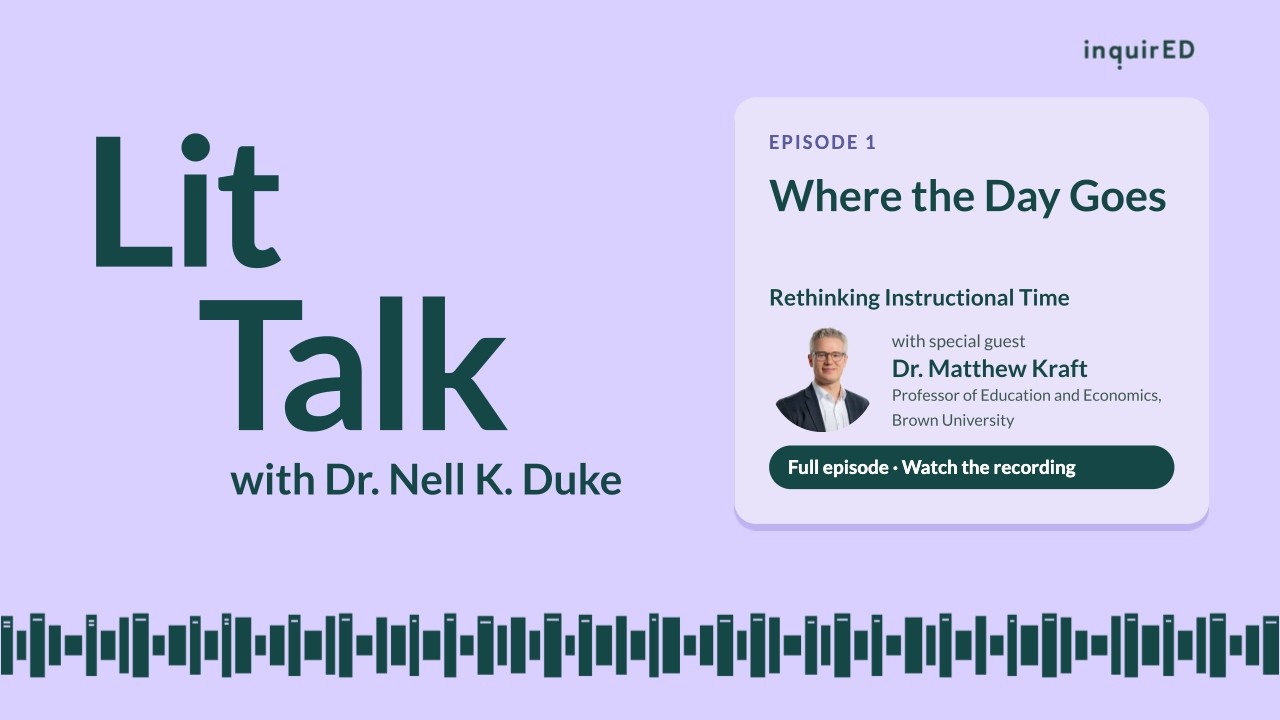
Dr. Matthew Kraft

Professor of Education and Economics | Brown University
Oct 18, 2026
8
MIN READ
Copied!

I am the text that will be copied.

Lit Talk with Dr. Nell K. Duke, Episode 1: Where the Day Goes, with special guest Dr. Matthew Kraft

NOTE: There is no recording for this webinar.

Webinars
BACK TO BLOG

Where the Day Goes: Rethinking Instructional Time

inquirED

Oct 18, 2026
8
MIN READ
Copied!

I am the text that will be copied.

Lit Talk with Dr. Nell K. Duke, Episode 1: Where the Day Goes, with special guest Dr. Matthew Kraft
Table of Contents
H1 Heading
H2 Heading
H3 Heading
in this recap
H2 Heading
H3 Heading
H4 Heading

K-5 Social Studies

illustration of kid holding question mark

K–2 integrated ELA and social studies

Next Lit Talk

Where the Day Goes: Rethinking Instructional Time in K–5 Classrooms

Reserve a seat →
Lit Talk
October 14, 2026
Next Lit Talk

Reading Comprehension in Question

Reserve a seat →
Lit Talk
December 2, 2026
Next Lit Talk

Want better reading? Teach writing better!

Reserve a seat →
Lit Talk
February 17, 2027
Next Lit Talk

Multilingual Reading: Building on Strengths, Advancing Practice

Reserve a seat →
Lit Talk
March 17, 2027

Every teacher and instructional leader knows the school day is short. In the first episode of Lit Talk with Dr. Nell K. Duke, Nell talked with Dr. Matthew Kraft, a professor of education and economics at Brown University, about how much time students actually have in school, where that time slips away, and what more time can and can't do. Nell closed with a first step any school can take: a time analysis.

Key Takeaways

  • Access to time varies widely. Schools at the 90th percentile of total time offer about 200 more hours a year than schools at the 10th percentile, roughly five and a half weeks of school.
  • Small losses add up. In one district Dr. Kraft studied, absences, suspensions, tardies, and outside interruptions cost about 16% of potential learning time in elementary school and up to 25% in high school.
  • The school day can't hold everything we ask of it. When Nell and colleagues built a first grade day with every subject at its recommended length, the day came up about two and a half hours short.
  • A time analysis shows exactly how one block of time is spent, so the changes a team makes start from evidence.

We're publishing two follow-ups to this episode: a time analysis tool your team can use to see where the day goes, and a post from Nell on the literacy practices that waste time and the ones worth the minutes. Subscribe to Lit Talk updates to get both as soon as they're out.

Students don't all get the same amount of school

Dr. Matthew Kraft traced his interest in time back to a meeting at a school about student absenteeism. Every few minutes, the intercom interrupted to call a student to the front office, and he started asking how often instruction gets interrupted and what it costs students.

He explained that time in school has two dimensions. The first is access: how long the school day and year are. The second is how much of that time becomes teaching and learning. Even the first question is hard to answer. State and school leaders often can't give basic facts about the length of their own school day and year, so his team gathered calendars district by district.

The typical student attends about 179 days a year for about 6.9 hours a day, roughly 1,230 hours of bell-to-bell time. The larger finding is the variation. Schools at the 10th percentile of total time offer about 200 fewer hours a year than schools at the 90th percentile, about five and a half weeks, which adds up to almost two years of instructional time across K–12.

“So we have this great and I think hidden inequity in access to time.”
Dr. Matthew Kraft

Where the minutes go, and what's in your control

Dr. Kraft walked through the many ways time is lost: days canceled for weather, teacher absences that substitutes can't fully replace, student absences, intercom announcements and knocks on the door, suspensions, early dismissals for athletics, and transitions that aren't as tight as they could be. In a case study of one district, absences, suspensions, tardies, and outside interruptions alone cost about 16% of potential learning time in elementary school and up to 25% in high school, before counting anything about how teachers manage their classrooms.

Some of that time is recoverable. Dr. Kraft estimated that cutting outside interruptions could win back 5–10% of it, and that tighter transitions and a coherent school policy on electronic devices could add another 5–10%, close to a day a week of potential instructional time.

For educators who don't set the calendar, he suggested two starting points. Teachers can keep a time diary for a week, recording each interruption, which makes for a stronger case than citing outside research. Anyone can compare their district's calendar with peer districts' and ask about the difference at a school board meeting.

“We don't need to fix everything all at once to make progress.”
Dr. Matthew Kraft

What gets squeezed when time runs short

In clips from conversations with instructional leaders, they described state mandates for literacy and math time that leave little room for science and social studies, and the pull toward covering standards quickly when there isn't time for depth.

Dr. Kraft said the research bears this out. When accountability systems test reading and math, schools respond, and history and science often get short shrift. Shortened periods also squeeze out whatever comes last in a lesson, such as student-to-student exploration and the exit ticket.

Nell connected this to literacy. The vocabulary, conceptual knowledge, and content knowledge students build in science and social studies are strong predictors of reading comprehension, yet those subjects are often cut in the name of improving literacy. She also described a recent SRI study that found the step most often dropped from phonics lessons was the chance for students to apply new patterns in actual reading. When a team knows it will run short of time, she said, it should decide deliberately what gets cut, so it isn't always the same crucial step.

Start here: analyze the time you already have

Nell shared a thought experiment from a chapter she wrote with Julia Lindsey and Crystal Wise for the Handbook on the Science of Early Literacy. They built a first grade day that included everything it's supposed to, at the length recommended for each part, from lunch and physical activity to social studies, science, literacy, and math. The day came up about two and a half hours short.

Any district or school can run the same exercise. Add up the time each curriculum calls for, add specials, lunch, and recess at recommended lengths, and compare the total with the day you have. When Nell has done this with districts, she often finds that it isn't possible to teach every curriculum for the time it calls for.

The next step is a time analysis, which shows where the time in your setting actually goes. All you need is an observer, a clock, and a notebook or laptop.

How to run a time analysis

  1. Get clear on why. Go in with a continuous improvement mindset. The goal is to find opportunities to use time better, and the analysis works best when everyone knows it isn't an evaluation.
  2. Decide who will observe and when. Pick one block to start.
  3. Pick your approach. Follow the whole class, or follow one or a few focal children, such as a student who is pulled often for tier two or tier three intervention, or a multilingual learner.
  4. Timestamp everything to the minute. Small stretches of time add up across days and years.
  5. Keep your notes low inference. Write what happened, such as "teacher calls students to the rug," and save judgments like "the transition dragged" for later.

One morning, minute by minute

Nell shared notes from a time analysis of one primary classroom. The doors opened at 8:50, and by 8:54 most children were doing worksheets. A breakfast group came in at 8:59. The teacher called the class to the rug at 9:17, most children were on the rug by 9:20, and the read-aloud began at 9:30, forty minutes after the doors opened.

The notes were factual, and they still revealed a lot.

  • Children who qualified for free breakfast were getting about nine minutes less classroom time every day, a structural issue worth addressing.
  • It took three minutes for even most of the class to reach the rug, and a discipline issue cost another three minutes.
  • Several activities, including most of the worksheet completion and dressing a teddy bear for the weather, aren't supported by research.

Looking at the full analysis, Nell said, almost the whole 40 minutes was not a research-aligned use of time.

Sort it against the research

To turn notes into decisions, look at each use of time and place it in one of three columns.

  • Research supports this. Protect it. For example, read-aloud, which research strongly supports in the primary grades.
  • Research is neutral, or we're not sure. Talk it through as a team. For example, daily oral language.
  • Research does not support this. This is where you'll find time. For example, most worksheet completion, dressing the teddy bear for the weather, and uninterrupted sustained silent reading (USSR) or DEAR time, which have more effective alternatives.

Name the kind of change

Once you see where time can be recovered, ask what it would take. Nell described three kinds of change:

  • Structural changes are systems-level issues, such as whether arrival and breakfast could happen differently. These often mean a conversation with school or district leadership.
  • Management changes involve transitions and behavior, such as how long it takes to move a class to the rug. They may call for new routines or a new way of storing materials.
  • Content changes concern what gets taught and how, such as whether calendar time is teaching what students need most, or what to prioritize within a curriculum.

A time analysis tool to walk your team through this process is coming in the next few weeks. Sign up for the Lit Talk newsletter to get it.

What this means for practice

Dr. Kraft's research gives district and state leaders hard questions about how much time students can access. For school leaders and teachers, the most immediate opportunity is the time already on the schedule, and a time analysis is a practical first step toward using it well. There are many points of entry into the time conversation, Nell reminded the audience, and each role has its own ways to make a difference.

Once a time analysis shows where your minutes go, the next question is which practices are worth them. Nell's upcoming post walks through common literacy time wasters and what to do instead. In the next few weeks, look for our follow up blog: Where the Day Goes: Making the Most of Literacy Time. Sign up for our newsletter to get direct access to more Lit Talk resources and tools.

Resources from the episode

  • Kraft and Novicoff, “Time in School,” American Educational Research Journal (2024), on how much time students have in school and how it varies (on Sagepub; direct link)
  • Kraft and Monti-Nussbaum, “The Big Problem With Little Interruptions to Classroom Learning,” AERA Open (2021) (on Sagepub; direct link)
  • Kraft, Blazar, and Hogan, “The Effect of Teacher Coaching on Instruction and Achievement: A Meta-Analysis of the Causal Evidence,” Review of Educational Research (2018) (on Sagepub; direct link)
  • Duke, Lindsey, and Wise, “Feeding Two Birds With One Hand: Instructional Simultaneity in Early Literacy Education,” in Handbook on the Science of Early Literacy (Guilford, 2023)
  • Jennerjohn, Rutherford-Quach, Cassidy, Woodworth, Dec, and Reynolds, “Bridging the Divide: Connecting Word Recognition and Language Comprehension in Early Literacy,” SRI learning brief (2026), the study Nell described on what gets left out of phonics lessons (direct link)

Closing reflection

Dr. Kraft's research points to a hidden inequity in how much time students get, and it also shows how much of what happens to that time is within reach. A district can compare its calendar with its neighbors', a school can cut down on interruptions during the day, and a teacher can start with one morning of timestamps. None of these steps requires fixing everything at once.

Next episode

Lit Talk returns Wednesday, December 2, at 3:45 p.m. CT, with an episode on reading comprehension and guest Dr. Gina Cervetti, whose work includes the integration of literacy and science and research on text sets. Register for the next Lit Talk episode.

Watch the recording

Resources

Keep reading

Name

previous

Name

Next

Where the Day Goes: Rethinking Instructional Time

By Design, Not By Accident: Building a Classroom Culture for Inquiry

Making Time for Elementary Social Studies: Priorities and Possibilities

“The People Doing the Talking Are Doing the Thinking”: Inquiry in Eastern Carver County Schools

How Waukee Built Equitable Access to Knowledge Through Complex Texts

Beyond Silos: Aligning Inclusive Instruction and Inquiry in Social Studies

Designing for Depth: Giving Writing Its Due in Early Literacy

Low Floors, High Ceilings: What’s Happening in Skokie Classrooms

From State Adoption to Classroom Instruction: Making Social Studies Materials Matter

How East Haven school district puts their vision of a graduate to practice

Writing for Meaning and Understanding: The Power of Integrated ELA and Social Studies

Deeper Knowledge and Comprehension Through ELA and Social Studies Integration

The Cognitive Load Problem: Why Too Many Programs Undermine Learning

The Elementary Time Problem: Too Much to Teach, Too Little Time

Canby Brings Oregon’s Vision for Social Science Education to Life

How Standards-Based Inquiry Sparked Innovation in Iowa City Community School District

How West Aurora Turned Social Science into Literacy Gains

Discourse and Differentiation: A Day in the Life of Inquiry in a 5th-Grade Classroom

Implementing Elementary Social Studies Across a District

The Missing Piece in Reading Comprehension: Social Studies

How SFUSD Brought Inquiry-Based Social Studies to Life

Culturally Responsive Education in Social Studies

How to Choose a High-Quality Elementary Social Studies Curriculum

Exploring the Inquiry Journeys Logic Model

How Oconomowoc made standards stick

Creative ways districts are making time for K-5 social studies

Your Guide to Meaningful Inquiry Walls in the Classroom

Using Inquiry in Elementary Social Studies

Think-Pair-Share | Inquiry Lesson Plan Strategy

Social Studies Projects: Give Students the Keys to Success

Can Curriculum-Based Professional Learning Transform Teaching?

Predict Learn Conclude | Inquiry Lesson Plan Strategy

Literacy in Social Studies: Layered Learning with Primary and Secondary Sources

Inquiry Journeys: Literacy Practices and Supports

Inquiry in Action: Classroom Spotlights

Creating a Roadmap for Social Studies Curriculum Review and Adoption

Wisconsin Makes The Case For Elementary Social Studies

"Yes, And..." | Inquiry Lesson Plan Strategy

Why Inquiry-Based Social Studies Matters in K–5 Classrooms

Elementary Social Studies | What is Informed Action?

What is Inquiry-Based Social Studies?

Inquiry in Social Studies Classrooms

What is the best inquiry process for elementary social studies curriculum?

Using Content-Area Literacy Strategies in Social Studies Instruction

Supporting the Shift to Inquiry

Keeping Curiosity Alive

Up to the Task: How to Support Student-Led Learning in Elementary Social Studies

Integrating SEL and Social Studies

Teaching in an Election Season: Rights and Responsibilities

Tell Me More: Using Diverse Books and Inquiry to Teach History

Voice and Choice in Inquiry-Based Learning

Using Primary Sources from the Library of Congress through Distance Learning

Un-level That Text! Integrating Literacy and Elementary Social Studies

Tools for Identifying High-Quality Social Studies Instruction

Time to Design: inquirED's Elementary Social Studies Curriculum Supports Teachers

The State of K-8 Social Studies

Bringing Learning to Life: The Power of Informed Action in Social Studies

The Social Studies ELA Connection: Making the Case For Elementary Social Studies

Theory to Practice: Implementing High-Quality Instruction

The Future of Social Studies: Webinar Series Launch

The Steps Toward Inquiry in Social Studies (Series Launch)

The Power of High-Quality Instructional Materials

Media Literacy: Making The Case For Elementary Social Studies

Social Studies in the Age of Disinformation: Making the Case For Elementary Social Studies

Storytime in Social Studies: Using Picture Books Across an Inquiry

Making the Case For Elementary Social Studies: District Leaders

Building Deep Background Knowledge: Making The Case For Elementary Social Studies

High-Quality Instructional Materials in Social Studies

Socratic Seminar | Inquiry Lesson Plan Strategy

Seen, Shared, Shaped Over Time: Making Learning Visible in Social Studies

The Social Studies Curriculum Review Guide

See Think Wonder | Inquiry Lesson Plan Strategy

Searching for Social Studies: Denver Public Schools

Media Literacy: Primary and Secondary Sources in Inquiry Journeys

Social Studies Curriculum Review and Adoption

Schema Building and Knowledge Transfer

Questioning: The Key to Unlocking the Power of Inquiry in Social Studies

What are your district's priorities for curriculum review and adoption?

Picture Walks and Other Pre-Reading Strategies for Early Literacy Development

Multimodal Learning in Inquiry Journeys

New Standards, New Directions: When Your State Goes All-In for Inquiry

Note Card Reflection | Inquiry Lesson Plan Strategy

Making Time for Elementary Social Studies

Layers of Meaning: Knowledge Building and Complex Texts

Sources as Mirrors and Windows: Making the Case for Elementary Social Studies

Mingle Pair Share | Inquiry Lesson Plan Strategy

Making the Case for Elementary Social Studies

Civic Life in the Era of Truth Decay: Making the Case for Elementary Social Studies

Inquiry Unit Design

Why Inquiry Skills Matter in K–5 Social Studies Classrooms

Inquiry Journeys: Elementary Social Studies Curriculum Resources

Inquiry vs. Knowledge Building: Dismantling the False Dichotomy

Inquiry-Based Elementary Social Studies and the C3 Framework

Inquiry Advocates: Partners with inquirED

Inquiry-Based Elementary Social Studies and the Common Core

Informed Action in Inquiry Journeys: A Garden Grows in Ohio

Inquiry-Based Learning: Research

inquirED's 21st Century Skills

Inquiry-Based Elementary Social Studies and the CASEL Competencies

Implementing Elementary Social Studies: Best Practices from District Leaders

Download now

Start your journey

Inquiry Journeys, inquirED's K-5 social studies curriculum, engages students in inquiry-based learning, strengthens literacy skills, and supports teachers every step of the way.

Get in touch
illustration of kid holding question mark

No items found.

inquirED supports teachers with high-quality instructional materials that make joyful, rigorous, and transferable learning possible for every student. Inkwell, our integrated core ELA and social studies elementary curriculum, brings ELA and social studies together into one coherent instructional block that builds deeper knowledge, comprehension, and literacy skills. Inquiry Journeys, our K–5 social studies curriculum, is used across the country to help students develop the deep content knowledge and inquiry skills essential for a thriving democracy,

Copied!

I am the text that will be copied.

Webinars

Subscribe to receive email updates from inquirED

Related posts

See all resources

Webinars

By Design, Not By Accident: Building a Classroom Culture for Inquiry

Sep 25, 2026
7
MIN READ

Webinars

Making Time for Elementary Social Studies: Priorities and Possibilities

May 7, 2026
9
MIN READ

Webinars

Beyond Silos: Aligning Inclusive Instruction and Inquiry in Social Studies

Mar 5, 2026
5
MIN READ
See all resources
Contact us

Contact sales

Ready to learn more?

Connect with someone from the inquirED team to schedule a demo or learn more about our products.

Connect with us

Want the latest webinars, resources, and tools? Sign up for inquirED’s newsletter.

About inquirED

About UsOur TeamCareers

Get in touch

General InquiriesSales

Contact sales

Social

LinkedIn
Instagram
Facebook
YouTube

© {year} inquirED Inc. All rights reserved.

Data + Security
|
Privacy Policy
|
Accessibility
|
Terms and Conditions